
Reselling diabetic test strips that Medicare or Medicaid paid for are illegal and have led to federal prosecutions involving diabetic test strip diversion schemes. Strips you bought with your own money, kept sealed and unexpired, generally can be resold under the first-sale doctrine, though safety and proof-of-ownership questions remain. Medicare Part B covers test strips with a prescription and set quantity limits. If you receive supplies you never ordered, call 1-800-MEDICARE and check your Medicare Summary Notice right away.
TL;DR:
- Medicare Part B generally covers up to 100 strips every three months without insulin or 300 with insulin; documented medical need can support higher quantities.
- Choose a supplier enrolled in Medicare who accepts assignment to keep your share at 20% coinsurance and avoid retail charges or coverage denials.
- Keep a dated receipt or payment statement and photos showing the sealed box, lot number, and expiration date, especially if the original receipt is unavailable.
- Unknown storage can undermine strip accuracy despite intact packaging; check seals, lot numbers, and expiration dates, and avoid products with unclear or damaged labels.
Table of Contents
- What Medicare Covers for Blood Glucose Test Strips
- How Supplier Rules Protect You From Billing Problems
- Is It Illegal to Resell Diabetic Test Strips?
- Safety and Quality Risks With Resold Test Strips
- Red Flags of Fraud and How to Report Diversion
- Selling Unused Sealed Strips the Lawful Way
- Florida Rules That Affect Reselling Medicare-Obtained Supplies
- Part D, Supplemental Plans, and What They Mean for Resale
- Proof of Ownership You’ll Need to Sell Compliantly
- Medicare Billing Rules That Determine Resale Eligibility
- Why Compliance Has to Come Before Convenience
- Sell Your Unused Supplies the Compliant Way in Orlando
- FAQ
- Sources
What Medicare Covers for Blood Glucose Test Strips
Medicare Part B pays for blood glucose monitors and test strips when your doctor documents that they’re medically necessary for managing diabetes. Coverage isn’t unlimited or automatic. It depends on your treatment plan, your prescription, and where you get your supplies.
Medicare.gov sets quantity guidelines that most beneficiaries fall under:
- Up to 100 test strips every three months if you don’t use insulin
- Up to 300 test strips every three months if you do use insulin
- More strips are allowed if your doctor documents a medical reason, such as frequent insulin dose adjustments
Your prescription needs to specify the type of monitor, how often you should test, and whether you use insulin. This detail matters because it’s what suppliers use to bill Medicare correctly. Prescriptions typically need to be renewed periodically, and your doctor’s office handles that renewal as part of your regular diabetes care visits.
You get the best value by using a supplier enrolled in Medicare who accepts assignment, meaning they agree to Medicare’s approved payment amount as full payment. Pharmacies that participate in Medicare work the same way. Going outside this network can mean paying more out of pocket or running into coverage denials.
How Supplier Rules Protect You From Billing Problems
Supplier enrollment and assignment rules exist to keep your costs predictable and your billing honest. Here’s what to know and do:
- Confirm your supplier is Medicare-enrolled and accepts assignment before you order anything, since this keeps your share of the cost at the standard 20% coinsurance rather than full retail price.
- Never accept test strips or monitors you didn’t request, and never let a supplier talk your doctor into “automatic” refills without your say-so, since CMS fraud prevention guidance flags unsolicited deliveries as a common fraud pattern.
- Review your Medicare Summary Notice every time one arrives, comparing what’s listed against what you actually requested and received.
- Keep your Medicare Beneficiary Identifier private, sharing it only with your doctor’s office and suppliers you’ve chosen yourself.
- Ask directly, “Do you accept Medicare assignment?” before giving any supplier your information. A legitimate supplier answers this without hesitation.
A partner guide on reading your Medicare Summary Notice walks through exactly what to check line by line, which is worth bookmarking if you’ve never looked closely at one before.
Is It Illegal to Resell Diabetic Test Strips?
Reselling test strips that were billed to Medicare or Medicaid is illegal, full stop. Federal prosecutors have pursued and won cases against people who collected diverted test strips and sold them back into the supply chain. In one case, two South Florida residents pleaded guilty to health care fraud charges tied to a diabetic test strip diversion scheme, part of a pattern of enforcement that has produced multimillion-dollar fraud recoveries.
CMS barred suppliers involved in more than $3.4 billion in suspected fraudulent billing during 2025 and 2026, using data analytics to flag and stop payments to bad actors before they could collect more. That scale shows how seriously Medicare treats supply diversion, and how far the enforcement net now reaches.
The first-sale doctrine is the legal nuance that matters for everyone else. If you bought strips with your own money, out of pocket, you generally have the right to resell them once you’ve legitimately purchased and owned them. This applies even if the strips are sealed and unexpired. The catch is provenance: a buyer or investigator has no easy way to tell your privately purchased box from one that was billed to Medicare and diverted, unless you can document the difference.
That’s why:
- Receipts matter. Keep proof you paid out of pocket, not through insurance billing.
- Never sell anything billed to Medicare or Medicaid, even if it’s unopened and sitting in a drawer.
- Unclear provenance creates legal risk for you and for anyone who buys from you, regardless of intent.
Safety and Quality Risks With Resold Test Strips
Even when resale is legal, the FDA warns that pre-owned test strips carry real safety risks, because storage conditions and handling history can’t be verified once a box leaves its original owner’s hands. Heat, humidity, and even repeated temperature swings during shipping can degrade the chemical strip inside without any visible change to the packaging.
Counterfeit and non-U.S. strips add another layer of risk, since they may not meet FDA manufacturing or accuracy standards even when the box looks legitimate. A strip that reads inaccurately doesn’t just produce a wrong number. It can lead you or a loved one to take too much or too little insulin, with consequences ranging from mild to dangerous. Our guide to common storage mistakes covers how temperature and humidity exposure happens even with careful owners.
Pro Tip: Before using any resold test strip, check for an intact seal, a clear lot number, and an expiration date at least several months out. If any of those are missing or illegible, don’t use it.
Red Flags of Fraud and How to Report Diversion
Diversion and billing fraud usually show warning signs before they become a legal problem for you. Watch for:
- Test strips, monitors, or other supplies arriving at your home that you never ordered and your doctor never discussed with you.
- Charges on your Medicare Summary Notice for supplies, visits, or equipment you don’t recognize.
- Phone calls or mailers offering “free” diabetic supplies in exchange for your Medicare number, which is a classic setup for billing fraud.
- A supplier who can’t or won’t confirm whether they’re Medicare-enrolled.
If you spot any of these, keep the original packaging and any paperwork that arrived with it. Check your next Medicare Summary Notice for matching charges, then call your doctor’s office to confirm whether they authorized the order. From there, call 1-800-MEDICARE to report what happened, and consider a report to the CMS Office of Inspector General with dates, supplier names, and amounts billed.
Protecting your Medicare Beneficiary Identifier is the single best defense here, since most diversion schemes depend on having that number to bill against. A partner resource on avoiding Medicare scams covers additional warning signs worth knowing before you ever get that first unsolicited call. Our own guide to spotting test strip scams covers the tactics that target people with diabetic supplies specifically.
Selling Unused Sealed Strips the Lawful Way
If you have unused, sealed test strips that you paid for out of pocket, there’s a legitimate path to sell them. Reputable buyers build their process around confirming that path exists before any money changes hands.
- Boxes should be sealed, unexpired, and show a visible lot number and expiration date.
- You should be able to show evidence the strips weren’t billed to Medicare or Medicaid, such as a pharmacy receipt showing a private purchase.
- Keeping dated photos of your unopened packaging adds another layer of documentation if questions ever come up.
A compliant in-person transaction typically involves a quick visual inspection, a check of the seal and codes, and payment on the spot once everything checks out. Our step-by-step guide to selling sealed test strips legally walks through exactly what to gather before you show up.
Florida Rules That Affect Reselling Medicare-Obtained Supplies
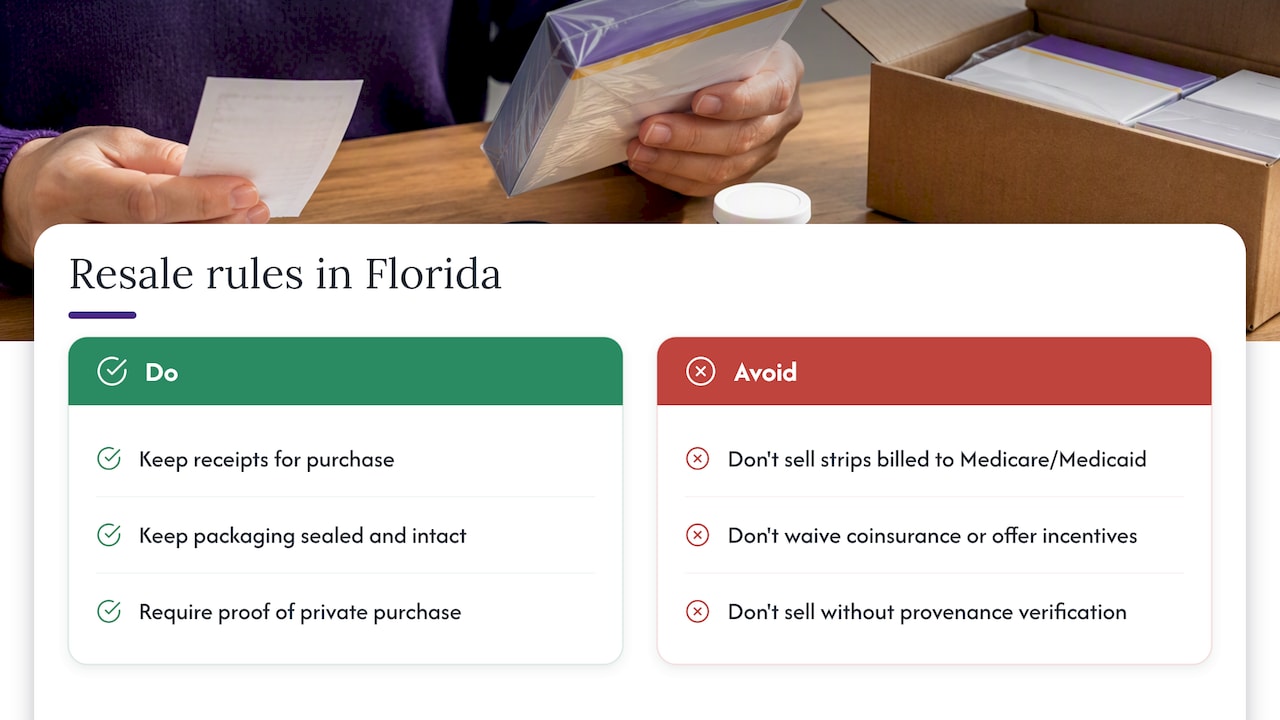
Florida doesn’t have a separate state statute that specifically licenses or bans the resale of diabetic test strips, which means the governing rules come from federal law: the anti-kickback statute, federal health care fraud statutes, and CMS program guidance on marketing practices tied to Medicare billing. That guidance, issued as Change Request 1336, specifically warns suppliers against waiving coinsurance or offering incentives that could violate 42 U.S.C. 1320a-7b(b), the federal anti-kickback statute.
What this means practically for Florida residents is that the resale question isn’t about state permits or state-specific selling laws. It’s about whether the supplies in question were ever billed to Medicare or Medicaid in the first place. South Florida has been a documented hotspot for test strip diversion prosecutions, which is part of why federal enforcement attention in this state has been active. That history doesn’t make private resale illegal here. It does mean buyers and sellers in Florida should expect more scrutiny around provenance than in a market with less enforcement activity.
If you’re selling strips you paid for privately, Florida law doesn’t add extra licensing burdens on top of the federal picture. The practical safeguard is the same one that applies everywhere: keep your receipts, keep your packaging intact, and work with buyers who ask the right questions before paying you.
Part D, Supplemental Plans, and What They Mean for Resale
Test strips fall under Medicare Part B, not Part D, because they’re classified as durable medical equipment supplies rather than prescription drugs. This distinction matters because it determines which coverage rules apply to you and, by extension, what counts as “Medicare-funded” for resale purposes.
If you have a Medicare Advantage plan (Part C) instead of Original Medicare, your test strip coverage still follows similar medical necessity and quantity standards, but the plan itself handles billing rather than Original Medicare directly. Supplemental Medigap policies don’t cover test strips independently. Instead, they help cover your Part B coinsurance and deductible on supplies that Original Medicare already approved.
None of this changes the core resale rule. Whether your strips were covered through Original Medicare, a Medicare Advantage plan, or with Medigap picking up your coinsurance, if any part of the public program paid toward them, they’re off-limits for resale. The coverage pathway affects your paperwork and your monthly costs. It doesn’t create a loophole for supplies that were ultimately paid for with program dollars.
Proof of Ownership You’ll Need to Sell Compliantly
Documentation is what separates a lawful private resale from a legal gray area. Before you try to sell any unused test strips, gather:
A pharmacy or retail receipt showing you paid out of pocket, with a date that lines up with when you acquired the box. If you don’t have the original receipt, a bank or credit card statement showing the purchase can serve as backup evidence. Photos of the sealed box showing the lot number and expiration date, taken before any sale, establish a timestamp for your ownership. If the strips came from a family member or estate, a simple written note explaining how you came to have them adds a layer of clarity that protects both you and any buyer.
None of this paperwork needs to be complicated. The goal is simply to be able to answer, clearly and quickly, how you got the strips and that no insurance program paid for them. Buyers who take compliance seriously will ask for this upfront, and sellers who have it ready move through the process faster.
Medicare Billing Rules That Determine Resale Eligibility
Understanding how Medicare pays for test strips in the first place clarifies why resale eligibility hinges on the payment source rather than on whether a box is open or sealed. When a Medicare-enrolled supplier bills for test strips, Medicare.gov coverage rules require a documented prescription, confirmation of medical necessity, and adherence to the standard quantity limits already covered above. The supplier submits a claim, Medicare pays its share, and you pay your 20% coinsurance if the supplier accepts assignment.
That payment, once made, attaches to the specific units billed. It doesn’t matter if you never opened the box or if your doctor changed your prescription the next month. If Medicare paid toward it, it was never yours to resell in the legal sense, because the reimbursement itself constitutes a benefit that federal fraud statutes protect against being monetized twice.
This is the dividing line that makes the whole resale question simple once you understand it: ownership for resale purposes isn’t about whether the box is sealed. It’s about whether a government program ever paid any part of the cost. Strips you bought entirely out of pocket never crossed that line, which is why they remain yours to resell under the first-sale doctrine discussed earlier.
Why Compliance Has to Come Before Convenience
The honest tension here is that beneficiaries end up with excess supplies for real reasons. Prescriptions change, devices get upgraded, and boxes pile up in a cabinet. The instinct to recoup some of that cost is reasonable, and the law does leave room for it when the strips were paid for privately.
Where I’d push back on the common framing is this: too many guides treat “sealed and unexpired” as the whole test. It isn’t. The payment source is the test, and provenance is the proof. Get that part right first.
— Liliana
Sell Your Unused Supplies the Compliant Way in Orlando
If you’re in the Orlando area with sealed, unexpired supplies you paid for privately, we buy diabetic supplies directly from you with same-day cash after a quick in-person inspection.

Some buyers purchase supplies that are owned outright and were never billed to Medicare or Medicaid. They typically ask to see sealed packaging and, where available, proof of a private purchase to ensure proper documentation.
- Commonly purchased items include sealed Dexcom sensors, FreeStyle Libre sensors, Omnipod pods, and major brand test strips.
- Inspection and payment may occur in person at a safe public location during the same visit.
- Keeping receipts and packaging intact can help speed up transactions.
Check our Dexcom G7 buyback details or our FreeStyle Libre 2 pricing to see what your unused boxes could be worth today.
This article is general information, not a substitute for advice from a qualified doctor. Consult a qualified healthcare professional about your own circumstances before acting on anything here.
FAQ
Is It Illegal to Sell My Diabetic Test Strips?
It depends entirely on how you got them. If Medicare or Medicaid paid for the strips, reselling them is illegal and has led to federal fraud prosecutions. If you paid for them yourself, out of pocket, you can generally resell sealed, unexpired boxes under the first-sale doctrine.
Will Medicare Pay for Test Strips?
Yes, Medicare Part B covers blood glucose test strips when your doctor documents medical necessity and writes a prescription. Typical quantity limits are up to 100 strips every three months if you don’t use insulin, or up to 300 if you do, with higher amounts allowed when documented as medically necessary.
Can You Sell Expired Test Strips?
No reputable buyer will purchase expired test strips, and using them yourself isn’t advisable either. The FDA warns that even unexpired, pre-owned strips carry accuracy risks tied to unknown storage history, so an expired box adds an additional layer of risk on top of that.
Where Can You Sell Unused Diabetic Test Strips?
You can sell privately purchased, sealed, unexpired test strips to local buyback services that verify ownership and inspect packaging in person before paying. If you’re in the Orlando area, we offer same-day cash for sealed supplies once we’ve confirmed they weren’t billed to Medicare or Medicaid.
Sources
- Two additional South Florida residents plead guilty to health care fraud charges in diabetic test strip diversion scheme | FDA
- Medicare