
A no-obligation supply quote is a price estimate a supplier gives you without creating any legal duty to buy. That’s the whole idea in one sentence. You can request one, compare it against others, sit on it for a week, and walk away without owing anyone a dime, unless you take a clear action like signing a purchase order or telling the supplier to start work.
Contract law backs this up. A binding agreement needs three things: an offer, acceptance of that offer, and consideration (something of value exchanged). A free quote by itself usually skips at least one of those steps, so no legal duty to buy exists until you actively accept it. At Orlando Diabetic Supplies Buyback, we build our entire process around this same principle. When you bring us unused Dexcom sensors or sealed test strips, our written estimate is exactly that: an estimate, not a contract, until you decide to sell.
Key Takeaways
A no-obligation supply quote gives you a price estimate with zero legal duty to buy, and only clear acceptance actions like signing a purchase order or authorizing work create a binding contract.
| Point | Details |
|---|---|
| Definition matters | A no-obligation quote is an estimate, not a contract, until you take a clear accepting action. |
| Ask for validity dates | Prices are a market snapshot; request how many days the quoted price stays firm. |
| Watch for binding language | Phrases indicating a limited validity period or conditional acceptance may signal a quote functions as a formal offer. |
| Know the trigger points | Issuing a purchase order, signing acceptance, or authorizing work usually creates a binding obligation. |
| Match the quote to the stakes | Small purchases are fine with non-binding quotes; large or financed purchases deserve a binding one. |
Primary Sources and Further Reading
- What Does No Obligation Mean in Contract Law? – LegalClarity: a clear explanation of contract formation basics and why no-obligation interactions don’t create legal duties.
- Request for Quotation (RFQ) definition and process – LegalClarity: breaks down how procurement RFQs work and when they become binding.
- Manufacturing quotation guide – SR-MFG: shows how formal quotations function in manufacturing and procurement settings.
- Request for quote (RFQ) – Investopedia: a straightforward reference for how RFQs support price comparison in business purchasing.
Table of Contents
- What Is No-Obligation Supply Quote Explained in Plain Terms?
- Non-Binding vs Binding Quotes: What’s the Real Difference?
- When Does a Quote Become Legally Binding?
- Where You’ll Actually See No-Obligation Quotes
- What to Ask Before You Trust a Supply Quote
- Should You Accept the Quote or Ask for a Binding One?
- Why Clear Quotes Matter in Our Buy-Back Process
- Frequently Asked Questions
- Sources
What Is No-Obligation Supply Quote Explained in Plain Terms?
“No-obligation” means you’re free to walk away. Nothing more, nothing less. The Collins Dictionary definition puts it plainly: “without obligation” means you aren’t required to do anything further after receiving the offer or information. Suppliers attach this phrase to quotes precisely to signal that requesting a price doesn’t lock you into a purchase.
But the words people use around quotes get muddy fast, and that confusion causes real problems. Here’s a quick glossary that clears things up:
- Estimate: A rough price prediction, often based on incomplete information, that both parties expect might change.
- Quote: A more specific price for defined goods or services, typically closer to what you’ll actually pay.
- Purchase quote: A quote tied to a specific transaction, sometimes formal enough to function as an offer once accepted.
- Proposal: A broader document that may include a quote alongside terms, timelines, and scope of work.
- Binding quotation: A price commitment the supplier can’t unilaterally change once you accept it, usually within a stated time window.
The line between these terms often comes down to one detail: the validity period. A quote is a snapshot of market conditions at a single moment, not a permanent promise. Without a stated end date, a supplier can adjust pricing later if material costs shift or time passes. That’s why asking “how long is this good for?” matters more than most people realize.
Here’s what a typical no-obligation quote might look like in practice:
Quote #4471 (No-Obligation, Valid 14 Days)
Item: Sealed test strip boxes, unopened, unexpired
Estimated cash value: a range depending on brand and expiration date, typically reflecting market conditions but not guaranteed
This quote is an estimate only and does not obligate either party until items are inspected and payment is agreed upon in person.
Notice the language doing the work there: “estimate only,” “does not obligate,” and a clear 14-day window. That’s a supplier being transparent, not evasive.
A supplier quotation typically lists more than just a number. It should include pricing, delivery terms, payment terms, and a validity period so both sides know exactly what’s being proposed before anyone commits to anything.
Non-Binding vs Binding Quotes: What’s the Real Difference?
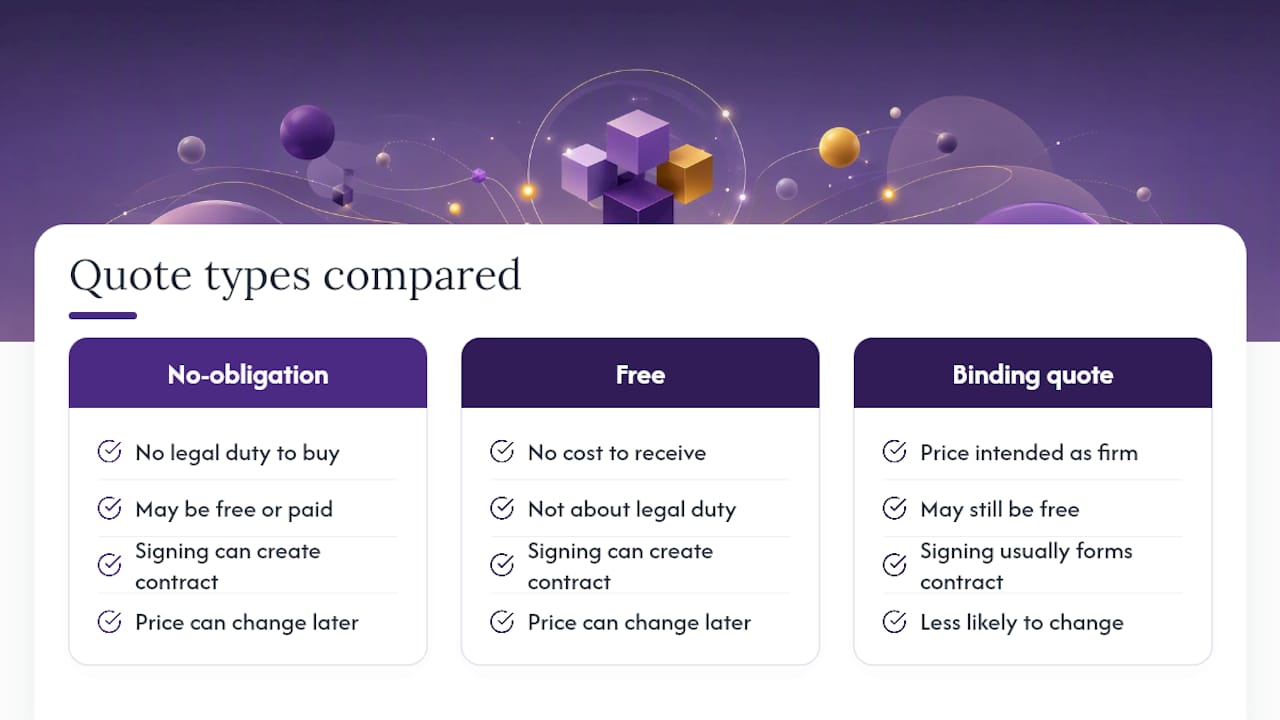
The gap between a non-binding quote and a binding one comes down to what each party can still walk away from. With a non-binding quote, either side can change their mind, revise pricing, or decline the deal entirely with no penalty. With a binding quote, once accepted, the supplier is locked into that price and the terms attached to it.
Certain phrases tip you off that a quote might carry more weight than a casual estimate. Watch for language like “firm for 30 days,” “this offer is valid upon signature,” or “subject to acceptance by [date].” A detailed quote sent in direct response to a specific request, especially one labeled “firm,” starts to resemble a formal offer rather than a casual estimate. Context and wording both matter here, not just the number itself.
Here’s how the two typically play out:
- Non-binding quote: Supplier can revise the price before you accept; you can walk away with no consequence.
- Binding quote: Once you accept, the supplier generally can’t raise the price without your agreement.
- Who can revoke: A supplier can typically withdraw a non-binding quote anytime before acceptance; revoking a binding quote after acceptance usually requires mutual consent.
- Silence isn’t acceptance: Simply not responding to a quote doesn’t turn it binding on either side.
Picture this: a homeowner requests a quote for gutter replacement. The contractor emails back a number labeled “estimate, subject to final measurement.” That’s non-binding. But if the homeowner then signs a proposal that says “I accept this quote and authorize work to begin,” and the contractor confirms the date, both sides have now created a contract. The quote didn’t bind anyone. The signature and confirmation did.
When Does a Quote Become Legally Binding?
Contract formation isn’t complicated once you break it down. Three things need to happen: someone makes an offer, the other party gives acceptance, and something of value changes hands, called consideration. A no-obligation quote usually only satisfies the first piece. Without acceptance and consideration, no contract exists yet, which is exactly why you can request ten quotes and reject nine of them without any legal fallout.
Certain actions flip that switch, though. Here’s the typical sequence that turns a quote into a binding obligation:
- Supplier sends a quote. No obligation exists yet on either side.
- Buyer reviews and requests changes or clarification. Still no obligation, this is just negotiation.
- Buyer issues a purchase order or signs an acceptance document. This is usually the moment acceptance happens.
- Supplier acknowledges the order. Now both offer and acceptance exist.
- Buyer authorizes work or payment begins. Consideration is now in motion, and a contract is formed.
The most common triggers that convert a casual quote into a binding deal include the buyer issuing a purchase order, the supplier formally acknowledging that order, the buyer explicitly authorizing work to begin, or the supplier starting work based on the buyer’s direct instructions. Any one of those can be enough.
To keep an interaction genuinely no-obligation, avoid a short list of actions:
- Don’t sign anything labeled “acceptance,” “authorization,” or “purchase order.”
- Don’t tell a supplier to “go ahead” or “start whenever” verbally or in writing.
- Don’t pay a deposit unless you intend to commit.
- Do ask for a written validity period before you do anything else.
One more wrinkle worth knowing: some in-person consumer sales come with legal cooling-off protections, meaning sellers may be required to provide written cancellation rights even after a signature. These rules vary by transaction type and location, so don’t assume every signed document is permanently locked in.
Pro Tip: If a supplier ever says “just sign here so we can lock in this price for you,” treat that as a green flag to slow down, not speed up. Locking in a price is exactly what turns a no-obligation quote into a commitment.
Where You’ll Actually See No-Obligation Quotes
The concept shows up everywhere, but the rules of thumb shift depending on the setting.
Home repair: A contractor’s initial walkthrough quote is almost always non-binding, since final costs depend on what they find once work starts. Treat these as directional, not final.
Insurance premium estimates: These are estimates built on the information you provide at the time; actual premiums often shift once underwriting reviews your full application. Don’t budget around the first number you see.
Event and catering quotes: Vendors typically issue a non-binding proposal first, then a binding contract once you confirm a date and put down a deposit. The deposit is usually the real turning point.
Procurement RFQs: A request for quotation is a formal document, but the RFQ process itself creates no contract. The buyer only forms a binding deal by accepting a vendor’s returned quote, often through a purchase order. This structure exists specifically to let buyers compare pricing across vendors before committing to anyone.
Medical supply buyback: When you bring unused diabetic supplies to a local buyer, the initial quote given before physical inspection is non-binding. Final pricing typically depends on verifying expiration dates and packaging condition in person, similar to how manufacturing quotations depend on confirmed specifications before a supplier commits to a firm number.

Pro Tip: If a quote depends on information that hasn’t been verified yet (measurements, inspection, underwriting), assume it’s non-binding no matter how confident the number sounds.
What to Ask Before You Trust a Supply Quote
A good no-obligation quote should tell you almost everything you need to know upfront. If it doesn’t, ask.
Request these five items in writing before you make any decision:
- Validity period: How many days is this price good for?
- Itemized pricing: What’s included in each line item, and what isn’t?
- Exclusions and assumptions: What conditions could change this price later?
- Delivery and payment terms: When is payment due, and how does delivery or completion work?
- Reference or quote number: Can you point back to this exact quote if pricing gets disputed later?
When you’re on the phone or in person with a supplier, a handful of direct questions will save you headaches down the line:
- “Is this quote binding or an estimate?”
- “How long is this price valid?”
- “What could cause this number to change?”
- “Is there a deposit required, and is it refundable?”
- “What happens if I need to cancel after accepting?”
- “Can you confirm this in writing or by email?”
Pro Tip: If you need financing or third-party approval before committing to a purchase, ask the supplier for a binding quote rather than an estimate. Lenders and approval boards often require a firm number, and a non-binding estimate won’t satisfy that requirement.
Negotiation gets easier once you know which parts of a quote are flexible. Assumptions and exclusions are usually where the real wiggle room lives, not the headline price. Push suppliers to spell those out rather than accepting a vague total.
Should You Accept the Quote or Ask for a Binding One?
Not every purchase needs the same level of certainty. Your decision should scale with what’s actually at stake.
For smaller purchases with stable pricing, a non-binding quote is usually fine. Buying sealed test strips, getting a quick repair estimate, or comparing catering options for a small gathering rarely justifies the extra paperwork of a binding contract.
Larger commitments call for more caution:
- Ask for a binding quote when: the project involves significant money, a long lead time, financing approval, or materials with volatile pricing.
- A non-binding quote is fine when: the purchase is small, low-risk, or easily reversible if plans change.
- Red flags that should push you toward a binding offer: a supplier who won’t put pricing in writing, pressure to decide immediately, or vague language about “final costs to be determined later.”
If you’re leaning toward a binding agreement, your next step is simple: ask the supplier directly for a firm quote with a signature line, and read every exclusion before you sign anything.
Why Clear Quotes Matter in Our Buy-Back Process
We built our buy-back process around the same idea this article walks through. When someone brings unused diabetic supplies to Orlando Diabetic Supplies Buyback, we give a written estimate before any inspection happens, and that estimate carries no obligation to sell. You can walk in, hear our number, and walk right back out. No pressure, no fine print designed to trap you.
Fairness only works if it’s paired with transparency. That’s why we inspect items in person and confirm final pricing before any cash changes hands, rather than locking in a number sight unseen. It protects you from surprises and protects us from disputes later. If you’re weighing whether to sell surplus Dexcom sensors, Freestyle Libre supplies, or unopened test strips, our guide on no-hassle supply selling walks through exactly what that estimate process looks like from start to finish.
Frequently Asked Questions
What do no-obligation quotes mean?
A no-obligation quote means you’re receiving a price estimate with no legal duty to buy. You can accept, reject, or ignore it entirely without any consequence, unless you take a separate action like signing an acceptance document.
What’s the difference between free and no-obligation?
“Free” refers to cost, meaning you don’t pay for the quote itself. “No-obligation” refers to legal duty, meaning receiving the quote doesn’t require you to purchase anything. A quote can be both free and no-obligation at the same time, which is the most common setup.
Can a supplier change the price after giving me a no-obligation quote?
Yes, especially if the quote didn’t include a stated validity period. Since a quote reflects a snapshot of pricing at one moment, suppliers can typically revise it later if time passes or costs shift, unless you’ve already accepted it under binding terms.
Does signing a quote automatically create a contract?
Not always, but it often does. If the document is labeled clearly as an “acceptance” or “purchase order” and you sign it, you’ve likely created a binding contract through offer and acceptance. Reading the label and language on any document before signing is the safest habit to build.
Is a home repair estimate the same as a binding quote?
No. Most home repair estimates are non-binding starting points, since actual costs often depend on what a contractor finds once work begins. A binding quote for repair work typically comes later, after a written proposal and signed agreement.
Ready to see what your unused diabetic supplies are worth? Get a no-obligation cash estimate from Orlando Diabetic Supplies Buyback today, with zero pressure to sell until you’re ready.
Sources
- What Does No Obligation Mean in Contract Law? – LegalClarity
- Engaged Scholarship business faculty publication — notes on quote validity and market snapshots
- Manufacturing quotation guide – SR-MFG
- Request for quote (RFQ) – Investopedia