If you find sealed, unexpired Dexcom sensors, FreeStyle Libre boxes, Omnipod pods, or test strips while settling an estate, you can sell them to a local buyer for same-day cash or donate them to an organization like Insulin for Life. The fastest lawful route is a local, in-person buy-back with a licensed buyer who inspects items on the spot. Check expiration dates and seals first, then inventory what you have and reach out today.
TL;DR:
- Only sealed, unexpired diabetes supplies such as CGM sensors, test strips, and unopened pods qualify for quick cash sales or donations, while opened or expired items almost always get rejected.
- Selling used medical supplies legally in the US is permitted for private, one-off sales, but you must confirm items are not under recall, wipe any stored data, and keep records of transactions.
- Preparing a detailed inventory with photos, serial numbers, and labels speeds up the process and reduces delays in sales or donations, especially when dealing with estate clearing.
- In-person local buy-back services offer same-day cash payments without shipping delays, while shipping or online sales take longer and pose higher fraud risks or platform restrictions.
- Executors should carry legal documentation, like letters testamentary, and complete an itemized checklist to ensure estate sales are legal, quick, and well-documented.
Table of Contents
- How To Sell Supplies After Death: What Actually Qualifies
- Is It Legal To Sell A Deceased Person’s Medical Supplies?
- Preparing Diabetic Supplies For Sale Or Donation
- Where Should You Sell Or Donate Estate Supplies?
- Executor Checklist: Completing The Sale Legally
- What Should You Expect To Get Paid?
- A Note From Liliana On Handling This Well
- Get Same-Day Cash For Diabetic Supplies In Orlando
- Sources
- FAQ
How To Sell Supplies After Death: What Actually Qualifies
Not everything in a loved one’s medicine cabinet has resale value, and knowing the difference saves you hours of wasted effort. Buyers and donation programs care about one thing above all else: whether the item is still sealed and still good.
Here’s what typically qualifies for a cash sale:
- Factory-sealed CGM sensors, including Dexcom G6 and G7
- Unopened FreeStyle Libre sensors
- Sealed, unexpired Omnipod pods
- Sealed boxes of test strips and lancets
- Unopened insulin vials or pens (though these more often go to donation than resale)
Items that get turned down almost every time: anything opened, anything past its printed expiration date, anything under an active recall, and any device that stores personal health data that hasn’t been wiped. A quick way to check recall status is searching the FDA’s medical device recall database by brand and lot number before you contact a buyer.
If items are expired or you’d rather not sell insulin, the American Diabetes Association points sellers toward Insulin for Life, which accepts many unexpired, unopened diabetes supplies. You’ll typically cover shipping to their donation center, but it’s a legitimate way to make sure supplies help someone instead of sitting in a drawer.
Is It Legal To Sell A Deceased Person’s Medical Supplies?
Yes, in most cases. Selling used medical equipment is legal in the United States, and private, one-off sellers are generally exempt from the licensing rules that apply to businesses that buy and resell medical devices regularly. The distinction that matters is commercial activity versus a single estate sale. You’re clearing out one household’s supplies, not running a resale operation, and that difference keeps things simple for most families.
Still, run through this checklist before you sell anything:
- Confirm the item isn’t under recall. Selling recalled medical devices, even unknowingly, can create liability for you as the seller.
- Wipe any stored data. CGMs and pumps can retain a patient’s glucose history or personal identifiers, and that data should be cleared before the item changes hands.
- Check the platform’s rules if you’re selling online. Many general marketplaces restrict or outright ban medical device listings, so read the fine print before you post anything.
- Keep a simple record of the sale. Note the date, the buyer’s name, what you sold, its condition, and how you were paid.
Pro Tip: Keep a receipt for every transaction, even a $20 test strip sale. Executors who document everything have far fewer disputes later with other heirs or with tax preparers.
One number worth remembering: private sellers who conduct occasional, non-commercial sales generally don’t need a dealer’s license, but that exemption disappears the moment selling becomes a regular business activity rather than a one-time estate cleanup.
Preparing Diabetic Supplies For Sale Or Donation
Buyers move faster when you’ve done the legwork first. A little organization up front translates directly into a quicker offer and less back-and-forth.
Start with a simple inventory. List the brand, model, lot or serial number, expiration date, quantity, and whether each item is still sealed. A basic spreadsheet works fine, and it gives buyers everything they need in one glance instead of asking follow-up questions. If you’re not sure where to start, this guide on organizing unused diabetes equipment walks through the sorting process step by step.
From there:
- Take clear photos of the full package, the expiration date, and the lot number
- Leave original packaging and factory seals untouched, don’t open anything to “check” it
- Gather any paperwork you have, including prescriptions, receipts, or proof of executor authority
- Label boxes by item type so buyers can inspect quickly during an in-person meeting
A detailed prep checklist for 2026 covers packaging and labeling in more depth if you’re dealing with a larger volume of supplies across multiple prescriptions.
Where Should You Sell Or Donate Estate Supplies?
Speed and value pull in opposite directions, and the right channel depends on which one matters more to you right now.
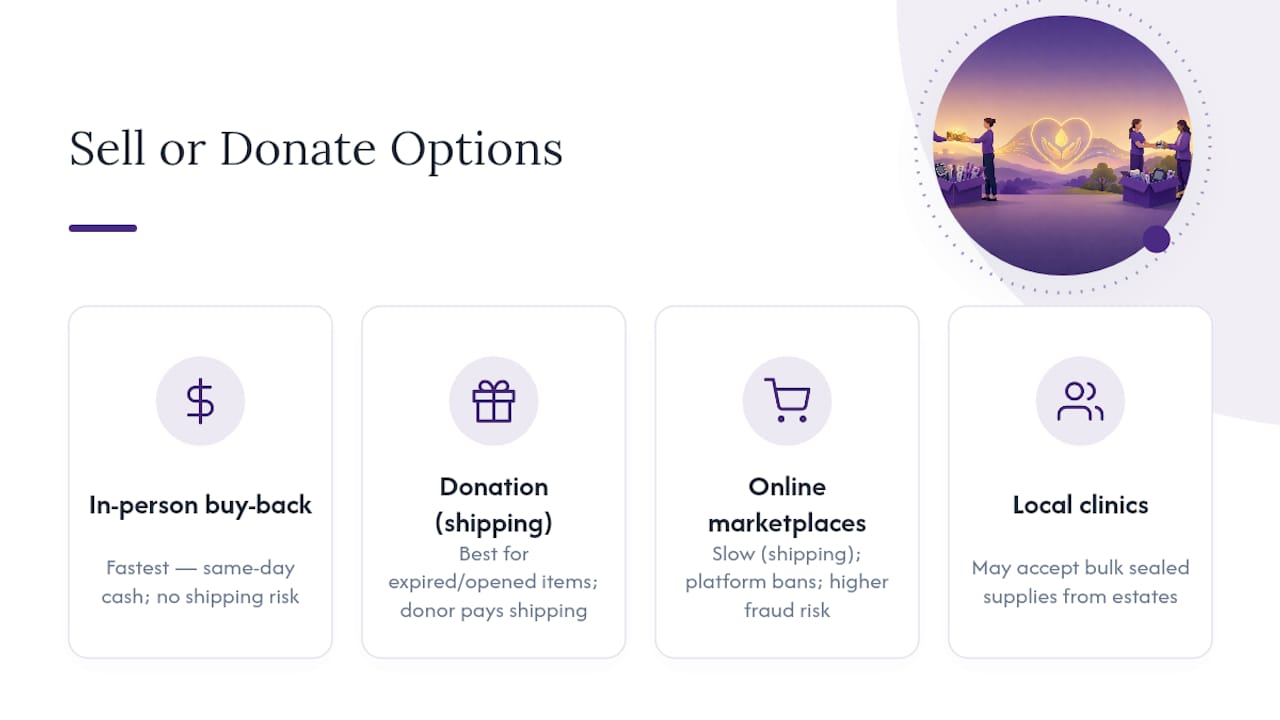
Local, in-person buy-back services offer the fastest path to cash. You bring sealed items to a safe public meeting spot, a buyer inspects them, and you walk away paid the same day. There’s no shipping, no waiting on a marketplace listing, and no risk of a package getting lost in transit.
Donation is the better fit when items are expired, opened, or you simply want them to help someone rather than sit in inventory. Insulin for Life can be reached at (352) 327-8649 and accepts a wide range of unexpired, unopened diabetes supplies, with the donor typically covering shipping.
Online marketplaces sit at the bottom of the list for most executors. Shipping adds days to the process, many platforms restrict or ban medical device listings outright, and mailing medical supplies to a stranger carries more fraud risk than handing them over in person.
If you’re sitting on a large volume of sealed test strips or pods, it’s also worth contacting local clinics or small medical practices, since some will take bulk sealed supplies off your hands even when a single buyer wouldn’t.
Executor Checklist: Completing The Sale Legally
Executors carry a specific responsibility here: you’re not just clearing a house, you’re managing someone else’s estate under a legal duty. A few steps keep that process clean.
- Confirm your authority to sell. Bring your letters testamentary, the will, or another form of executor ID to any meeting with a buyer.
- Prepare your itemized list and photos. Buyers move faster when they can see condition and quantity before you even arrive.
- Choose a safe meeting location. A public spot during daylight hours protects both you and the buyer.
- Get an itemized receipt and immediate payment. Cash or an instant electronic transfer beats waiting on a check or a mailed payment.
- Insure any shipped items. If a buyer requires shipping, get tracking and insurance rather than risking supplies in transit uninsured.
A step-by-step guide to converting unused supplies into cash is worth reading if this is your first time handling an estate transaction like this.
What Should You Expect To Get Paid?
Pricing varies by brand, expiration window, and how many units you’re selling, but here’s a general sense of the range:
- Sealed test strips: modest amounts depending on brand and expiration
The trade-off is straightforward: a same-day, in-person sale is fast and certain, but it typically pays less per item than shipping to a large wholesale buyer who takes weeks to process and pay. If certainty and speed matter more to you than squeezing out the last dollar, that’s the honest calculation to make.
Timeline-wise, an in-person local sale closes in a single meeting. Shipping-based sales to distant buyers or brokers commonly take anywhere from three days to two weeks, and that’s before accounting for return shipping if an item gets rejected on arrival.
A Note From Liliana On Handling This Well
Every week I hear from families going through nearly the same situation. Someone passed, and now there’s a drawer full of sealed CGM boxes or test strips nobody knows what to do with. The two mistakes I see most: people try to sell items that have already been opened (buyers will always decline these), and people show up without any paperwork proving they have the authority to sell on behalf of the estate.
Neither mistake is fatal, they’re just fixable with a little planning. Check your seals and expiration dates before you contact anyone. Bring your letters testamentary if you’re the executor. And pick the route that actually matches how fast you need this resolved, whether that’s a same-day local sale or a slower donation to an organization that will put the supplies to good use.
— Liliana
Get Same-Day Cash For Diabetic Supplies In Orlando
Orlando Diabetic Supplies Buyback offers what shipping-based buyers and general marketplaces cannot: a same-day, in-person cash sale with no waiting on mail, no listing fees, and no risk of a package going missing. This service buys sealed, unexpired Dexcom G6 and G7 sensors, FreeStyle Libre sensors, Omnipod pods, and major-brand test strips, and pays on the spot after a quick inspection.
Before you reach out, gather your inventory list, any executor paperwork if you’re settling an estate, and photos of the sealed packaging. That’s everything you need for a fast meeting. We’ll walk through pricing together in person, based on brand, expiration, and quantity, and you’ll leave with cash in hand instead of a pending shipment. Start by checking what you have on hand and its current cash value, or look up specific pricing for Dexcom G7 sensors or FreeStyle Libre 2 sensors before you schedule a meetup.
This article is general information, not a substitute for advice from a qualified doctor. Consult a qualified healthcare professional about your own circumstances before acting on anything here.
Sources
- Where to Donate Diabetes Supplies | Donate Insulin Pens & Glucose Monitors
- Is It Legal to Sell Used Medical Equipment in 2026?
- Is It Legal to Sell Used Medical Equipment? (2026 Guide)
FAQ
Can You Legally Sell A Deceased Person’s Diabetic Supplies?
Yes. Private, occasional sales of used medical equipment are generally exempt from dealer licensing requirements in most states, as long as you’re not running an ongoing resale business.
What Diabetic Supplies Have The Most Resale Value?
Sealed CGM sensors typically fetch the most. Unused, unexpired Dexcom G7 packs sell for $70 to $90 per pack, while FreeStyle Libre 2 sensors run $15 to $20 per sensor.
What If Supplies Are Expired Or Already Opened?
Expired or opened supplies generally can’t be sold or safely used by another patient. Donating unexpired, unopened items to a program like Insulin for Life is usually the better option, and expired items should simply be disposed of properly.
Does Orlando Diabetic Supplies Buyback Buy From Estates?
Yes. Orlando Diabetic Supplies Buyback purchases sealed, unexpired Dexcom G6 and G7 sensors, FreeStyle Libre sensors, Omnipod pods, and major-brand test strips, and pays same-day cash after an in-person inspection. Current pricing for specific items is listed on the Dexcom G7 buyback page and FreeStyle Libre 2 buyback page.
Do I Need An Executor Letter To Sell Diabetic Supplies?
It’s strongly recommended. Bringing letters testamentary or another form of executor ID to the sale protects you and reassures buyers that you have the legal authority to sell items belonging to the estate.