
A quantity limit is a non-dollar cap your insurer places on how much of a supply or medication you can receive in a given period. Think fills per month, days’ supply per prescription, or sensor counts per quarter. The American Diabetes Association recommends checking your Summary of Benefits and Coverage (SoBC) or calling your insurer directly to confirm exactly what limits apply to your diabetic supplies. If you have leftover sealed items, that check also tells you whether those supplies were billed to insurance, which matters before you sell them.
Here is what to do right now:
- Pull your SoBC from your insurer’s member portal or HR department.
- Look up your pharmacy formulary for your specific supply (test strips, CGM sensors, insulin pump pods).
- Call the member services number on your insurance card and ask: “Were my last fills billed to my plan, and do I have any quantity limits on these items?”
- Note whether any items were covered under Medicare or Medicaid, since federal program rules may restrict resale.
Table of Contents
- How do insurance quantity limits work for diabetics?
- What prior authorization and appeals mean for your supply levels
- Why do diabetics end up with leftover supplies?
- Legal and Medicare/Medicaid rules to check before you sell
- How to prepare unused diabetic supplies so buyers trust them
- Where can you sell or donate unused diabetic supplies?
- Key Takeaways
- What local buyers actually look for
- Orlando Diabetic Supplies Buyback pays same-day cash for sealed supplies
- Useful sources for further reading
- What local buyers actually look for
How do insurance quantity limits work for diabetics?
The Affordable Care Act bans annual and lifetime dollar limits on essential health benefits, but it does not ban non-dollar quantity caps. That distinction is the reason your plan can legally cap you at a 30-day supply of test strips or limit Dexcom G6 sensors to a set count per quarter, even while it cannot put a ceiling on total dollar spending for covered benefits.
Pharmacy benefit managers (PBMs) are the companies that actually write and enforce these rules on behalf of your insurer. They build formulary tables that specify:
- Day-supply limits: 30-day, 28-day, or 84-day fills depending on the drug or device category.
- Fills per period: For example, a plan may allow three pens per 84-day window or a fixed sensor count per month.
- Starter vs. maintenance pack rules: Insurers often map starter packs to a 21-day or 25-day fill window, while maintenance packs align to 63-day or 75-day windows, per [Aetna’s quantity limit policy](https://www.aetna.com/products/rxnonmedicare/data/2024/Antidiabetic_GLP-1,_GIP-GLP-1_Agonist_Limit_Policy_4525-H_05-2024.html).
- Per-product limits: Limits do not always stack across different drugs or strengths. You may receive the maximum allowed for each product separately, which is one reason multi-product supply scenarios can leave patients with varying quantities across brands.
Pharmacies have discretion to dispense based on manufacturer package sizes, which often results in the actual day supply recorded on a claim being less than the plan’s stated maximum. This commonly leads to sealed, partial boxes remaining unused.
Pro Tip: Ask your pharmacist to print your fill history. It shows the day supply recorded per transaction, which tells you at a glance how close you are to your plan’s limit and whether any fills came in short.

PBMs like OptumRx have tightened quantity limits and added new prior-authorization options in recent years, so limits that applied to your plan last year may have changed. Re-check your formulary at every open enrollment.
What prior authorization and appeals mean for your supply levels
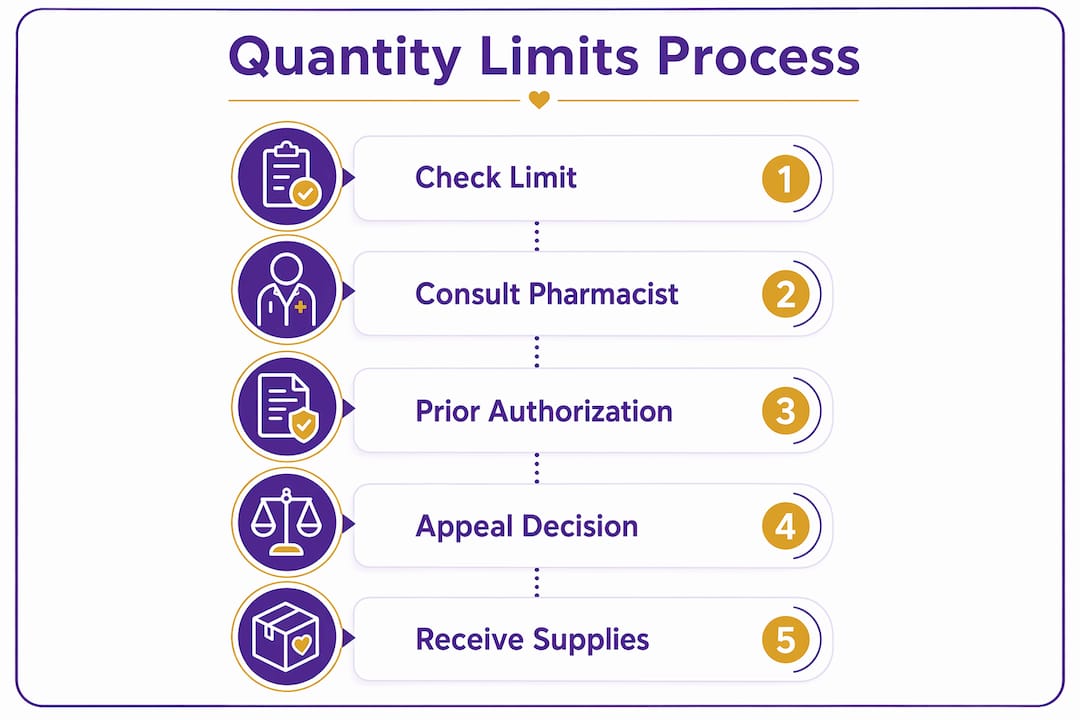
Prior authorization (PA) is the process where your insurer verifies medical necessity before approving a fill that exceeds standard quantity limits. Step therapy adds another layer: the plan may require you to try a lower-cost option before it approves the preferred device or medication.
Here is how the PA and appeals process typically works:
- Your prescriber submits a PA request with your diagnosis, treatment history, and a clinical justification explaining why the requested quantity is medically necessary.
- The insurer reviews against program limits. BCBSNC’s prior-authorization criteria show that approval is granted when the requested quantity does not exceed the program limit, or when the prescriber documents why a higher quantity is necessary.
- If denied, you or your prescriber can appeal. The appeal should include a physician note, relevant medical records, and a clear statement of why the standard limit is inadequate for your condition.
- Timelines vary: Standard PA decisions typically arrive within a few business days; urgent requests are faster. Appeals can take longer, so file promptly.
Quantity limit windows reset on different schedules. Monthly resets are common for test strips and lancets. CGM sensors and insulin pump supplies often reset on a 90-day or quarterly cycle. Annual resets apply to some durable medical equipment. Knowing your reset date helps you plan refills without creating unnecessary surplus.
Pro Tip: Ask your prescriber to avoid writing “dispense as written” (DAW) on the prescription when clinically appropriate. Allowing generic or formulary substitution can reduce denials tied to quantity limits and improve your coverage flexibility. You can also review common insurance errors to avoid before your next refill.
Why do diabetics end up with leftover supplies?
Surplus supplies are more common than most people realize. Several predictable patterns create them:
- Coverage timing mismatches. Your insurer covers a 30-day supply, but your prescriber writes for 90 days. The pharmacy fills in 30-day increments, and refill timing rarely lines up perfectly with actual usage.
- Device switches. Upgrading from a Dexcom G6 to a Dexcom G7 leaves G6 sensors unused. Switching glucose meters leaves sealed test strips that no longer match your device. The same applies when moving to FreeStyle Libre from a fingerstick-based system.
- Starter pack overages. Starter packs often include more units than a patient uses before transitioning to a maintenance pack, leaving sealed pods or sensors behind.
- PA denials resolved late. A prior authorization denial gets appealed and approved weeks later, but you already adapted your routine. The originally filled supplies sit untouched.
- Duplicate fills. Multiple prescribers or fills from different pharmacies can result in overlapping supplies, especially when prescription details like 30-day vs. 90-day scripts are not coordinated.
These scenarios regularly produce sealed, in-date Dexcom G6 sensors, Dexcom G7 sensors, FreeStyle Libre sensors, Omnipod cartridges, and sealed test strips. All of these are items Orlando Diabetic Supplies Buyback accepts when they meet condition requirements.
Legal and Medicare/Medicaid rules to check before you sell
Selling unused diabetic supplies is legal in most situations, but a few specific circumstances require extra caution.
- ACA context: Non-dollar quantity limits are permitted under federal law. The ACA’s prohibition covers only dollar caps on essential health benefits, not supply counts or fill frequencies.
- Medicare and Medicaid: If your supplies were covered under a federal or state program, resale may conflict with program rules or contractor policies. Verify with your program administrator before selling any items billed to Medicare or Medicaid.
- Insurer contractual language: Some private plans include terms about supplies purchased with plan benefits. Review your plan documents or ask your insurer directly whether resale is restricted.
- Documentation to keep: Retain receipts, explanation of benefits (EOB) statements, and any claim information that shows how the item was paid for. This protects you and speeds appraisal with a local buyer.
Before selling any supply covered by a federal or state program, contact your insurer or program administrator and ask for a written confirmation of any restrictions. A quick call now can prevent a much larger problem later.
For Florida-specific guidance on what qualifies for diabetic supply payment, check the state-level rules that apply to your situation.
This article is general information, not legal or medical advice. Confirm current rules with your insurer, program administrator, or a qualified professional for your specific situation.
How to prepare unused diabetic supplies so buyers trust them
Good documentation speeds appraisal and gets you a better offer. Here is what to have ready:
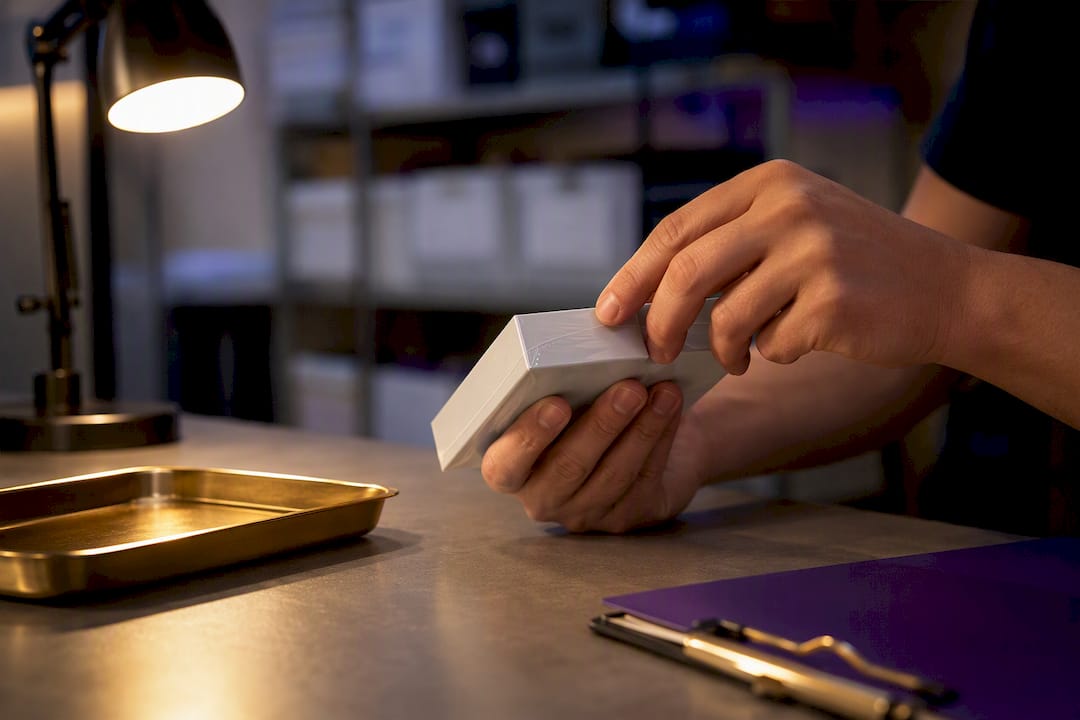
- Keep original sealed packaging. Never open a box you plan to sell. Sealed condition is the single most important factor for local buyers.
- Record lot and serial numbers. These appear on the box label. Photograph them clearly before you bring items in.
- Note expiration dates. Buyers will not accept expired supplies. Check dates before you make the trip.
- Keep proof of purchase when possible. A receipt, EOB, or pharmacy printout showing the purchase date adds credibility and confirms the item’s history.
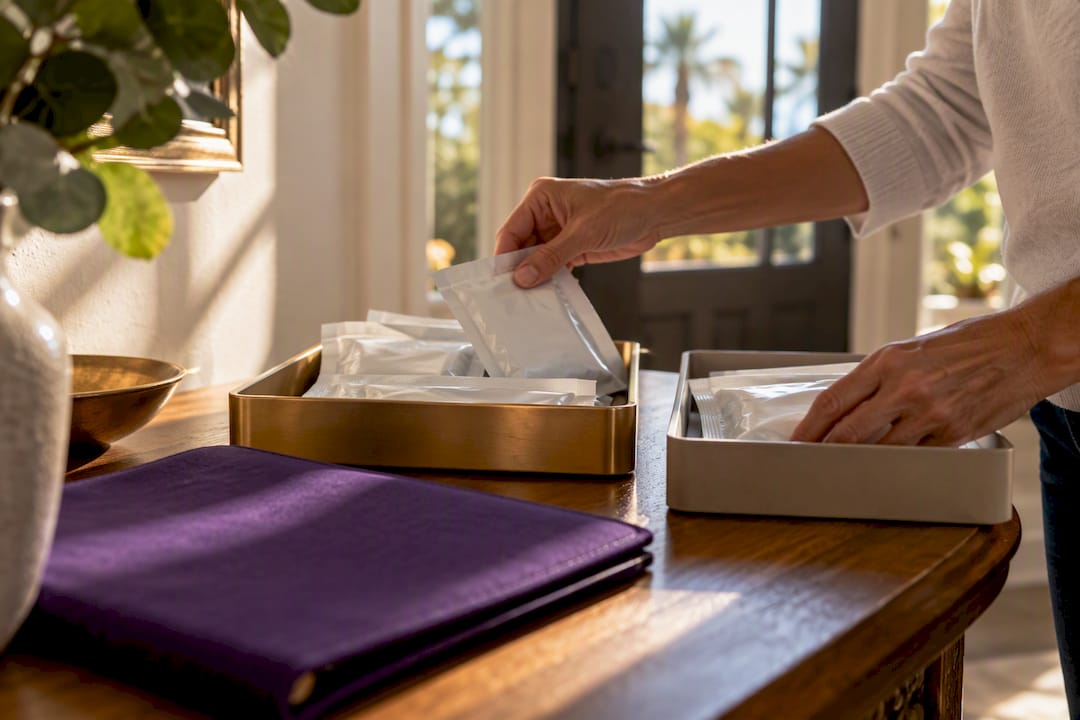
- Photograph everything. Take close-ups of the sealed packaging, lot number, and expiration date. Add one wide shot showing all items together for a quick inventory overview.
- Prepare an itemized list. Write down each item by brand and model: Dexcom G7, FreeStyle Libre 3, Omnipod 5, and so on. This speeds the appraisal process significantly.
- Store items correctly until pickup. Keep sensors and strips at the manufacturer’s recommended temperature and humidity. Heat and moisture damage supplies even inside sealed boxes.
Pro Tip: Review the seller checklist for insurance-covered overstock before your appointment. Arriving pre-documented means same-day cash is a realistic outcome, not a maybe.
Where can you sell or donate unused diabetic supplies?
Three realistic paths exist, each with clear tradeoffs.
Local buy-back services like Orlando Diabetic Supplies Buyback offer the fastest, most straightforward option. You bring sealed, in-date items with documentation, and you can walk away with cash the same day. No shipping, no waiting for a buyer to respond, and no platform fees. The tradeoff is that local buyers have specific acceptance criteria, so condition and documentation matter.
Donation programs serve a real community need. Community health clinics and nonprofit organizations accept certain sealed supplies for patients who cannot afford them. The benefit is obvious. The limitation is that acceptance rules vary widely by organization, and not every item qualifies. Some programs only accept specific brands or require supplies to have at least six months before expiration.
Online marketplaces reach a wider audience and can work for higher-value items like sealed Omnipod pods or CGM sensors. The downsides are real: higher fraud risk, platform rules that restrict medical supply listings, and the logistical burden of shipping. Verify listing rules carefully before posting.
For sealed test strips, CGM sensors, and insulin pump supplies, a local buy-back is almost always the fastest and lowest-risk path. Online options make more sense when you have a large quantity and time to wait for the right buyer.
Safety note: never sell opened or used consumables. Buyers accept only sealed, manufacturer-intact items.
Key Takeaways
Insurance quantity limits are non-dollar caps set by insurers and PBMs that restrict fills per period, days’ supply, and device counts, and they routinely create sealed surplus supplies that Orlando sellers can convert to cash.
| Point | Details |
|---|---|
| Check your SoBC first | Confirm quantity limits and whether items were billed to insurance before selling anything. |
| Medicare/Medicaid items need extra care | Federal and state program rules may restrict resale; verify in writing before proceeding. |
| Documentation speeds appraisal | Sealed packaging, lot numbers, expiration dates, and proof of purchase get you faster, better offers. |
| Device switches create the most surplus | Upgrading from Dexcom G6 to G7 or switching to FreeStyle Libre often leaves sealed sensors unused. |
| Orlando Diabetic Supplies Buyback | Accepts sealed Dexcom G6/G7, FreeStyle Libre, Omnipod, and test strips for same-day cash in Orlando. |
What local buyers actually look for
When someone brings supplies to Orlando Diabetic Supplies Buyback, the appraisal comes down to a few straightforward things. Sealed condition is first. If the manufacturer’s packaging is intact, the lot number is visible, and the expiration date gives reasonable time remaining, the item is worth evaluating. Dexcom G6 and G7 sensors, FreeStyle Libre sensors, Omnipod pods, and sealed test strips are the items we see most often and accept most readily.
Pre-documented items move fastest. When a seller arrives with an itemized list, clear photos, and a receipt or EOB, same-day cash is a real possibility. When items arrive loose, unlabeled, or with no provenance information, the appraisal takes longer and the offer may reflect the added uncertainty.
For items that do not meet acceptance criteria, responsible disposal matters. Local buyers who follow proper practices will direct you to safe disposal options rather than leaving you to figure it out alone.
Orlando Diabetic Supplies Buyback pays same-day cash for sealed supplies
If you have sealed Dexcom G6 or G7 sensors, FreeStyle Libre sensors, Omnipod pods, or sealed test strips sitting unused, Orlando Diabetic Supplies Buyback offers a fast, local, and honest appraisal. No shipping, no waiting, no platform fees.
Bring your itemized list and photos to speed the process. You can also start with a phone or web estimate before you make the trip. Same-day pickup and drop-off options are available for Orlando and surrounding areas.
Visit how to get cash for unused diabetic supplies to see exactly what we buy and how the process works. Ready to sell your Dexcom G7 sensors specifically? Check the Dexcom G7 sell page for current acceptance details and next steps.
Useful sources for further reading
- American Diabetes Association: Health Insurance Marketplace and People with Diabetes — ADA guidance on reviewing your SoBC and understanding plan protections.
- National Conference of State Legislatures: Diabetes State Mandates and Insulin Copayment Caps — ACA rules on essential health benefits, dollar-limit prohibitions, and state-level insulin caps.
- Aetna: Antidiabetic GLP-1 Quantity Limit Policy — A real-world example of how fill limits, package sizes, and day-supply windows are written into insurer policy.
- BCBSNC: GLP-1 Prior Authorization with Quantity Limit (Medicare Part D) — Shows how PA exceptions work when requested quantities exceed program limits.
- PharmaDossier: OptumRx GLP-1 Coverage and 2025–2026 Updates — PBM-level changes that illustrate why quantity limits shift year to year.
- Healthline: Navigating Insurance for GLP-1s — Practical consumer tips including DAW strategy and 30-day vs. 90-day supply planning.
- Orlando Diabetic Supplies Buyback: Private Insurance Diabetic Supply Categories Explained — Local guidance on how insurance categories affect which supplies qualify for buy-back.
What local buyers actually look for
Removed duplicate section — see the perspective section above.