Copay assistance raises the volume of sealed diabetic supplies entering the resale market, but not through some simple math of “cheaper copay equals more surplus.” A peer-reviewed study of Medicare and Medicaid patients found oversupply prevalence as high as 11% in publicly insured groups, compared to roughly 2% among privately insured patients, tied largely to 90-day fills and looser utilization checks. Meanwhile, surplus-recovery programs show that unopened, unexpired supplies exist at real scale and can be redirected safely.
For you, the practical takeaway is this:
- Lower friction on refills tends to produce more sealed leftovers, not fewer.
- Device switches and therapy changes matter more than copay price alone.
- If you’re buying or selling locally, expect supply to track insurance cycles and device upgrade seasons more than any single cost factor.
Key Takeaways
Copay assistance increases resale supply volume mainly by encouraging 90-day fills and auto-refills that outpace the speed of therapy and device changes.
| Point | Details |
|---|---|
| Verdict is nuanced | Copay assistance raises surplus mainly through refill timing, not through cost reduction alone. |
| Payer type matters | Oversupply reached up to 11% in Medicare/Medicaid groups versus about 2% among privately insured patients. |
| Device switches drive leftovers | CGM and insulin changes create sealed surplus regardless of what the copay was. |
| Sealed and unexpired is non-negotiable | Buyback eligibility depends on intact packaging and remaining shelf life, not the reason for surplus. |
| Orlando Diabetic Supplies Buyback offers same-day resolution | Local, in-person inspection and cash payment beat shipping supplies to an unverified online buyer. |
Table of Contents
- How Copay Assistance Affects Supply Volume Through Refill Behavior
- What Does the Research Say About Oversupply and Surplus?
- Which Items Actually Show Up in the Resale Market?
- How Should You Prepare Supplies to Sell or Buy?
- Frequently Asked Questions
- Sources
How Copay Assistance Affects Supply Volume Through Refill Behavior
The direct mechanism is refill friction. When copay assistance drops out-of-pocket costs to near zero, patients are more likely to fill on schedule, including 90-day supplies, rather than skipping or delaying pickups. That sounds like it should reduce waste. It often does the opposite.
Here’s the sequence that actually plays out for a lot of households:
- A patient enrolls in a manufacturer copay card or assistance program, making refills essentially free or low-cost.
- An auto-refill or 90-day fill arrives on schedule, sometimes right before a doctor changes the prescription or device.
- The therapy or device switch happens anyway, because insulin types get adjusted, CGM brands get swapped, or a new pump model replaces an old one.
- The most recent fill, still sealed, becomes surplus because it no longer matches the current prescription.
Notice that step three has nothing to do with the copay itself. It’s the timing mismatch between an automated refill cycle and a clinical decision that creates the leftover. Research on medication oversupply backs this up directly: 90-day fills are associated with leftover supplies specifically because they lock in a larger quantity right before circumstances change.
Utilization-management systems act as a partial counterforce. Insurers and pharmacy benefit managers increasingly flag therapeutic duplication and can slow down or deny early refills, which trims some of the oversupply that would otherwise pile up. But that control is uneven. It works better for privately insured patients with tighter formulary rules than for Medicare and Medicaid populations, where the same study found oversupply rates several times higher.
Concrete surplus-producing events look like this in practice: a Dexcom G6 user upgrades to a G7 mid-box, a patient’s endocrinologist switches insulin brands after a formulary change, or a caregiver clears out a deceased relative’s diabetic supplies. Each event has nothing to do with whether copay assistance existed, and everything to do with how supply chains and clinical decisions rarely sync perfectly.
Pro Tip: If you’ve just switched CGM brands or insulin types, check your last 90-day fill before tossing anything. Sealed boxes from the old prescription are often exactly what buyback services want.
Related reading on how refill scheduling and continuity of care interact with device switching can help you spot the pattern in your own supply closet.
What Does the Research Say About Oversupply and Surplus?
The clearest empirical link between insurance structure and surplus comes from a peer-reviewed analysis of diabetes patients, which found:
- Oversupply was notably higher among Medicare and Medicaid enrollees.
- Privately insured patients showed much lower oversupply.
- Ninety-day fills correlated with leftover supplies across payer types, though the effect was strongest in publicly insured groups.
That gap matters for anyone trying to predict where resale supply will come from. Publicly insured populations, who typically face fewer utilization checks and rely more heavily on 90-day fills, generate a disproportionate share of sealed surplus.
Separately, Insulin for Life’s surplus-to-care model demonstrates that recoverable surplus exists at a scale worth building formal systems around, not just informal trades. The program’s success at routing unopened supplies to clinics proves the volume is real and recurring, not a rounding error.
On the demand side, research into informal exchange behavior found that financial stress predicts trading, donating, and purchasing diabetes supplies outside formal channels. That’s the flip side of the supply story: people with surplus and people who need supplies are both motivated to find each other, copay assistance or not.
One limitation worth flagging honestly: most of this evidence comes from structured healthcare settings, not resale marketplaces themselves. Buyback and gray-market activity is drawing more clinical and policy attention, but hard numbers on resale volume specifically are thinner than the oversupply research behind it. Treat the connection as strongly supported, not perfectly measured.
Which Items Actually Show Up in the Resale Market?
Test strips, CGM sensors, and insulin pump pods dominate what circulates through buyback channels, and the timing of that supply tracks predictable events rather than random chance.

Industry reporting on the diabetic supply buyback market identifies these as the most commonly resold categories, largely because they’re the items patients accumulate fastest through routine refills and are also the easiest to verify as sealed and unexpired. Pods and sensors carry brand-specific compatibility, which makes eligibility checks straightforward for a buyer.
Timing clusters around a few recurring windows:
- Device upgrade cycles, when a CGM brand or model change leaves the previous generation’s sensors unused.
- The tail end of 90-day fill periods, especially when they overlap with a prescription change.
- Estate and caregiver cleanouts, which tend to surface large single lots rather than a trickle.
Larger volumes entering the market at once can soften resale prices, simple supply and demand. But that same volume is exactly what expands access for buyers who are underinsured or between coverage, echoing the exchange-activity research on financially stressed patients seeking supplies outside formal channels.
Regulatory and safety limits keep the market from becoming a free-for-all. Reputable buyback operations require factory-sealed packaging and meaningful shelf life remaining, typically several months at minimum, before they’ll purchase an item. Anything opened, expired, or without intact packaging gets rejected, both for legal reasons and because a reseller can’t verify how it was stored. If you’re weighing surplus after a device change, understanding why medication switches create leftovers helps you separate what’s sellable from what should go to disposal instead.
How Should You Prepare Supplies to Sell or Buy?
Selling or buying diabetic surplus safely comes down to verification, and the checklist is short enough to run through in a few minutes.
If you’re selling:
- Confirm every box is factory-sealed with the manufacturer’s tamper seal intact.
- Check the expiration date and note how many months of shelf life remain.
- Take clear photos of the box, lot number, and expiration date before you list or bring items in.
- Note the quantity and, if relevant, when the device or prescription switch happened.
If you’re buying, verify sealed packaging yourself, confirm the model matches your device, and ask basic provenance questions: how was it stored, and why is the seller parting with it. A seller who can’t answer either question calmly is a signal to walk away.
Pro Tip: If your surplus resulted from a death in the family or a major device switch, consider splitting it. Sell a portion to a local buyback service for immediate cash and route anything you’re unsure about to a donation repository instead.
Timing your sale around known upgrade cycles, rather than waiting, tends to get you better pricing before a wave of similar surplus hits the market.
What Orlando Diabetic Supplies Buyback Sees on the Ground
We see the same three drivers over and over: CGM brand switches, 90-day auto-refill cutovers landing awkwardly after a prescription change, and caregivers clearing out a loved one’s unused supplies. Same-day buyback volume rises noticeably in the weeks after major device launches and open enrollment periods, then levels off. One recent seller brought in three sealed boxes of sensors left over after switching models. Sealed, unexpired, correct lot numbers. Payment took about ten minutes.
Turn Surplus Into Same-Day Cash Locally
Orlando Diabetic Supplies Buyback is the direct alternative to shipping supplies off to an anonymous online buyer and hoping for a fair price weeks later. We inspect items in person and pay cash the same day, no waiting on a check or a “we’ll review and get back to you” email.
We purchase sealed, unexpired Dexcom G6 and G7 sensors, Freestyle Libre sensors, Omnipod pods, and major test strip brands, following the same eligibility standards reputable buyback operations use industry-wide: factory-sealed packaging and enough shelf life remaining to resell responsibly. The process is simple. Bring your items in for inspection, get a fair on-the-spot offer, and walk out with cash, or arrange local pickup if that’s easier. A local, in-person buyback also protects you from the risks of shipping supplies to a stranger online with no verification and no recourse if the deal falls through.
If you’ve got sealed CGM sensors, pods, or test strips sitting in a drawer after a device switch or a loved one’s care needs changed, find out how to get cash for unused diabetic supplies today.
Frequently Asked Questions
Does copay assistance always increase surplus supply?
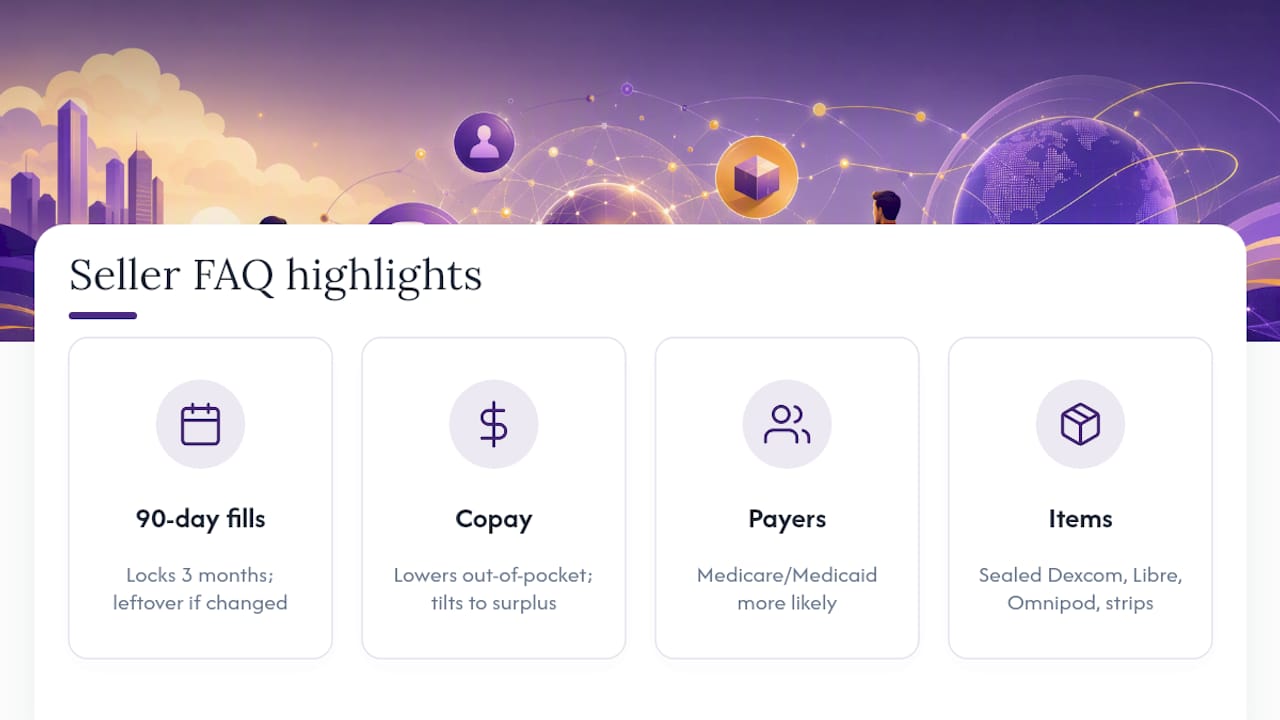
Not always, but it tilts the odds that way. Lower out-of-pocket costs make patients more likely to fill on schedule, and when a 90-day fill overlaps with a therapy or device change, the leftover becomes sealed surplus rather than being skipped entirely.
Why does 90-day fill length matter more than copay price?
A 90-day fill locks in three months of supply at once. If a device or medication changes even a few weeks later, that entire remaining quantity becomes leftover, regardless of what the patient paid for it.
Are Medicare and Medicaid patients more likely to generate resaleable surplus?
Data suggests so.
What items does Orlando Diabetic Supplies Buyback accept?
Sealed, unexpired Dexcom G6 and G7 sensors, Freestyle Libre sensors, Omnipod pods, and major test strip brands, provided packaging is factory-sealed and shelf life remains adequate.
Should I donate surplus supplies instead of selling them?
Both paths are legitimate. Donation repositories route supplies to clinics and patients in need, while a local buyback gets you same-day cash. Many sellers split larger surplus lots between the two.
Sources
- Medication Oversupply in Patients with Diabetes – PMC
- Surplus-to-Care: A Systems Approach to Expanding Insulin and Diabetes Supplies Access – Grantmakers In Health
- How the Diabetic Supply Buyback Market Is Solving a $5 Billion Healthcare Waste Problem – TechBullion