
Insurance-managed auto-shipment is when a supplier coordinates recurring diabetes supply orders, bills your insurer, and ships sensors, test strips, or pods on a schedule tied to your coverage, not just to your calendar. That’s the answer to what is insurance supply auto-shipment explained. It’s not fully automatic, though. Your shipments still depend on refill eligibility windows, and most suppliers must contact you before dispensing a refill. Prescription and prior authorization status can hold up an order even when everything else looks fine.
Here’s what matters right now:
- Confirm your supplier accepts assignment with your insurer, so you’re not billed the difference.
- Check that your prescription is current. An expired script stalls shipments even when your refill window is open.
- Ask what your expected delivery window looks like, since it varies by plan and item.
Key Takeaways
Insurance-managed auto-shipment works because suppliers must verify eligibility and confirm refills with you before shipping, not because the process runs on autopilot.
| Point | Details |
|---|---|
| It’s not fully automatic | CMS requires suppliers to contact you and get an affirmative response before dispensing most DMEPOS refills. |
| Channel choice affects cost | Pharmacy benefits usually cover insulin, while DME benefits cover CGMs, strips, and pump supplies, each with different rules. |
| Documentation prevents denials | Keep prescriptions current and save proof-of-delivery records to resolve billing disputes faster. |
| Timing follows eligibility windows | Most maintenance supplies ship on a 90-day cadence tied to usage windows, not a fixed calendar date. |
| Surplus has a real market | Orlando Diabetic Supplies Buyback pays same-day cash for sealed, unexpired Dexcom, Libre, Omnipod, and test strip supplies. |
Table of Contents
- How Insurance Supply Auto-Shipment Actually Works
- Pharmacy Benefits vs. DME: Why the Channel You Use Matters
- When Should You Expect Your Refill Shipment?
- What Should You Do When a Shipment Goes Wrong?
- What Can You Do With Leftover Diabetes Supplies?
- Why Understanding This Process Protects You
- Turn Unused Diabetes Supplies Into Same-Day Cash
- Sources
How Insurance Supply Auto-Shipment Actually Works
Three parties touch every shipment: you, your supplier, and your insurer. Understanding who does what saves you a lot of phone calls later.
Here’s the general sequence:
- Your supplier verifies coverage. Before anything ships, the supplier confirms your insurance is active, checks whether your prescription supports the item requested, and files any prior authorization the insurer requires.
- Eligibility gets checked against your usage windows. CGM sensors have wear schedules, test strips have monthly allowances, and pump supplies follow their own cadence. Suppliers track these dates so they know when you’re actually due for a refill, not just when it would be convenient to ship.
- Someone contacts you before the item goes out. Larger suppliers often reach out proactively. AdaptHealth, for example, monitors refill timing and initiates prescription renewal requests with your provider when your script is nearing its end, which helps prevent a gap between shipments.
- The order ships, and the supplier documents delivery. Proof of delivery isn’t paperwork for paperwork’s sake. It’s the record insurers use to justify payment, and gaps in that documentation can delay or jeopardize coverage on future orders.
Pro Tip: Save the tracking confirmation or delivery text for at least one full refill cycle. If a claim ever gets questioned, that record is often the fastest way to resolve it.
Some suppliers run this more tightly than others. Sego Medical Supply’s own FAQ states plainly that nothing ships until coverage is verified and confirmed, which is a good sign of a supplier doing this correctly rather than shipping first and sorting out billing later.
Pharmacy Benefits vs. DME: Why the Channel You Use Matters
Not every diabetes supply travels through the same insurance channel, and using the wrong one is one of the fastest ways to get an unexpected bill.
- Pharmacy benefits usually cover insulin and some other prescription medications, often through mail-order pharmacy programs that ship a 90-day supply at a time.
- Durable medical equipment (DME) benefits typically cover CGM sensors, test strips, and pump supplies, routed through DME suppliers rather than a pharmacy.
- Coverage rules, copays, and quantity allowances differ between the two, and Children’s Hospital of Philadelphia’s guidance notes this distinction directly affects how much you pay and whether mail order is even an option for a given item.
Send a CGM order through the wrong channel, and you risk a denied claim, a misrouted shipment, or a bill you shouldn’t owe. If you’re unsure which channel applies to your equipment, our breakdown of private insurance supply categories walks through how insurers typically split coverage.
When Should You Expect Your Refill Shipment?
Timing questions come up constantly, and the honest answer is “it depends on your documentation.” When insurance paperwork is already on file, processing can move in as little as a handful of business days; when it’s not, expect longer waits while the supplier chases authorization. The Center for Medicare & Medicaid Services (CMS) requires that DME suppliers contact you and document your affirmative response before dispensing many refills, and they cannot simply ship on a fixed schedule without that check-in.
Most maintenance supplies typically follow a quarterly cadence, meaning a few reorders per year rather than a monthly shipment. Some continuity programs, like Edgepark’s, reach out 10 to 14 days ahead of a scheduled shipment to confirm you still need it and check your current inventory first.
A few things commonly delay shipments:
- An expired prescription that hasn’t been renewed by your provider yet.
- A prior authorization that lapsed or was never filed.
- No response to the supplier’s contact attempt, which under CMS rules blocks the refill entirely.
Our guide to managing diabetes supplies covers these reorder windows in more detail if you want to plan around them.
What Should You Do When a Shipment Goes Wrong?
Denials, duplicate deliveries, and address mix-ups are the three complaints that come up most often with insurance-managed refills. None of them are unusual, and all of them have a fairly direct fix.
- Verify your supplier’s status first. Confirm they’re enrolled with your insurer and accept assignment, and check that your prescription or prior authorization is current before you assume something’s broken.
- If a shipment is denied or billed to you, call the supplier first. Ask for the proof of delivery and the specific claim denial reason code. Then call your insurer with that information in hand.
- If you’re traveling, moving, or switching devices, notify your supplier and provider early. A new address or a new device model needs to be on file before your next scheduled shipment, not after it arrives at the wrong place.
Pro Tip: Keep your provider’s renewal timeline a few weeks ahead of your actual refill date. Prescriptions that lapse right before a shipment window cause more denials than almost anything else.
If quantity limits are the recurring issue, our explainer on insurance quantity limits breaks down why insurers cap certain items and how to request an exception when your usage genuinely exceeds the standard allowance.
What Can You Do With Leftover Diabetes Supplies?
Surplus supplies are common, and they’re rarely anyone’s fault. A 90-day mail-order cadence combined with a device switch, a change in prescribed quantity, or a hospital stay that interrupts your usual routine can leave you with sealed boxes you don’t need.
You have a few honest paths forward:
- Disposal. Follow your local guidelines for medical supply and sharps disposal rather than tossing sensors or lancets in regular trash.
- Donation. Some clinics and diabetes support organizations accept sealed, unexpired supplies, though restrictions vary by organization and location.
- Resale or buy-back. Sealed, unexpired items like CGM sensors, pods, and test strips can often be sold to a local buyer rather than sitting in a drawer past their expiration date.
If your surplus keeps building up cycle after cycle, our guide on reducing diabetic supply buildup looks at how to better align your ordering cadence with what you actually use. And if you’d simply rather manage supplies through a different model altogether, direct-access lab testing is one example of how self-pay routes work outside the insurance channel, which can be worth understanding if insurer rules are frustrating you regularly.
Why Understanding This Process Protects You
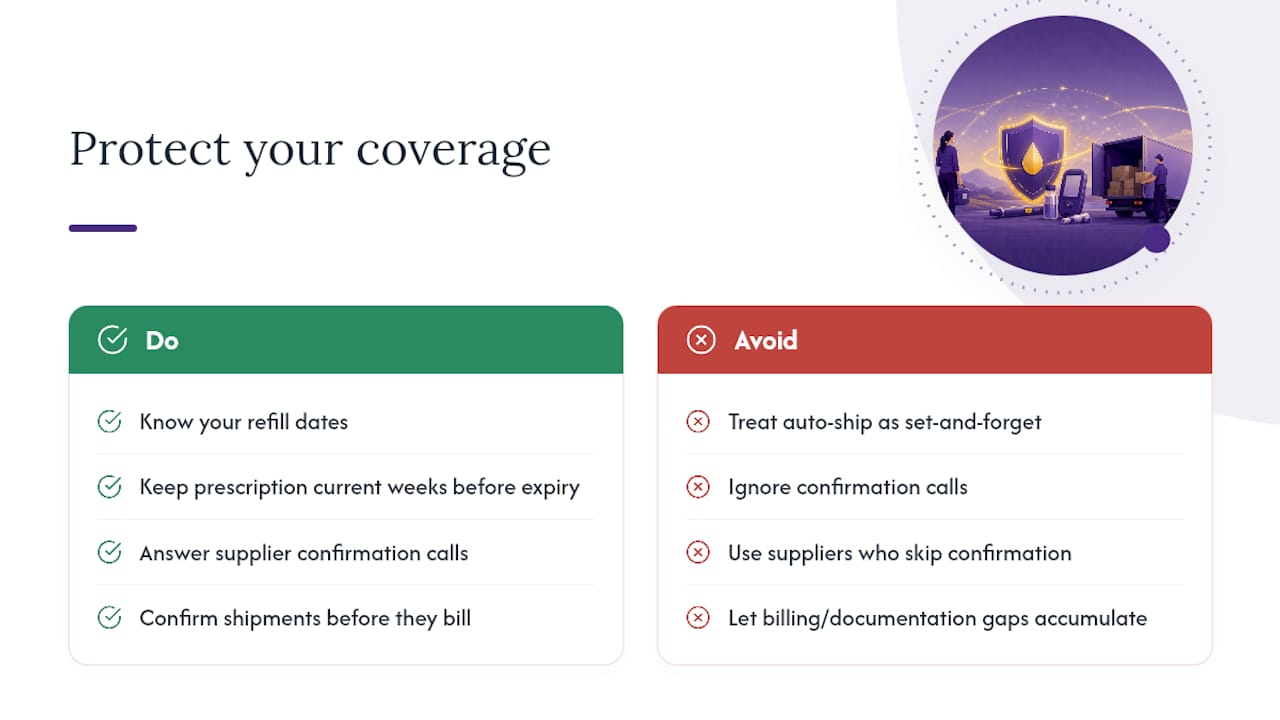
Most people treat “auto-shipment” as a set-it-and-forget-it feature, and that’s the exact assumption that gets people into trouble. The CMS contact-before-refill rule exists precisely because fully automatic, no-questions-asked shipping led to waste, billing disputes, and supplies arriving that patients didn’t actually need yet. Suppliers that skip the confirmation step aren’t doing you a favor by being “more automatic.” They’re cutting a corner that eventually shows up as a denied claim or a documentation gap you have to untangle months later.
The patients who avoid the most headaches aren’t the ones with the fanciest supplier app. They’re the ones who know their own refill dates, keep their prescription current a few weeks ahead of expiration, and actually answer the phone when the supplier calls to confirm a shipment. That single habit, answering the confirmation call, sidesteps most of the denials and delays described above. Everything else in this process is designed around insurers protecting themselves from paying for supplies nobody asked for. Once you see it that way, the extra verification steps stop feeling like bureaucracy and start feeling like the reason your coverage stays intact.
Turn Unused Diabetes Supplies Into Same-Day Cash
If your auto-shipments have left you with sealed boxes you’ll never use, Orlando Diabetic Supplies Buyback pays same-day cash on the spot instead of leaving you to manage a return, a donation drop-off, or an online resale listing that takes weeks to close.
We buy Dexcom G6 and G7 sensors, FreeStyle Libre supplies, Omnipod pods, and sealed, unexpired major-brand test strips. The process is straightforward: bring your unopened, unexpired items in for a quick in-person inspection, and if they qualify, you get paid on the spot in cash or an electronic transfer, whichever you prefer. There’s no shipping, no waiting for a check, and no guessing whether a listing will ever sell.
If your supply cadence keeps outpacing what you actually use, see how to get cash for your unused diabetic supplies and find out what your current stockpile might be worth before it expires on a shelf.
Sources
- LCD – Glucose Monitors (L33822)
- AdaptHealth: simplify your diabetes supply refills
- Edgepark: how continuity programs help therapy compliance