

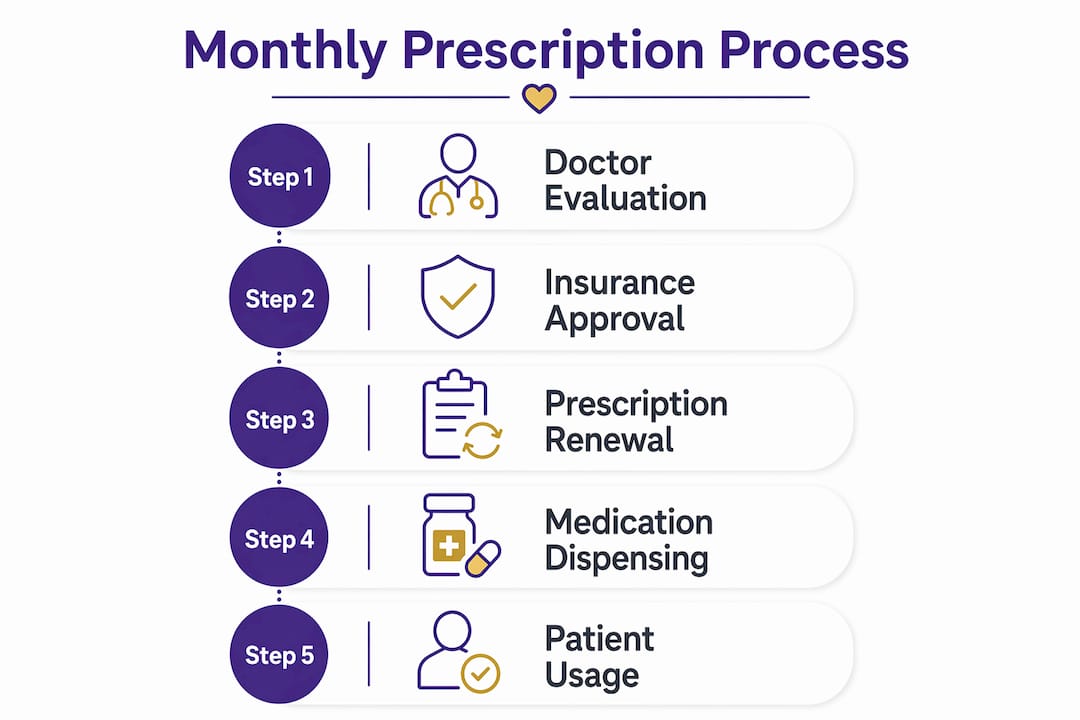
Diabetic supplies are prescribed monthly because insurance providers and Medicare require controlled refill cycles to verify appropriate use, prevent waste, and maintain clinical oversight. This monthly prescription pattern is not arbitrary. It reflects a system built around insurance refill windows, medical necessity documentation, and Centers for Medicare and Medicaid Services billing rules that govern how often suppliers can dispense and bill for diabetes management supplies. Understanding why diabetic supplies prescribed monthly works this way helps you avoid coverage gaps, manage your inventory better, and stay ahead of prescription renewals.
Why are diabetic supplies prescribed monthly?
Monthly prescriptions for diabetic supplies are the result of insurance and Medicare billing cycles, not a clinical requirement set by your doctor alone. Most pharmacy benefit managers and private insurers operate on 30-day refill windows. That means your coverage resets every month, and your supplier can only bill for a new batch of supplies once the previous supply period has elapsed.
Medicare Part B sets quantity limits at 300 test strips and lancets per quarter for insulin-treated patients, and 100 per quarter for non-insulin users. Those are quarterly caps, but billing and shipment cycles often break down into monthly increments to match standard insurance practices. The result is that most patients experience their supplies arriving or being refilled on a monthly schedule, even when the underlying policy allows for longer intervals.

Prescriptions also require annual renewal to keep coverage valid. Your doctor must sign off each year, confirming that your treatment plan still requires the supplies being dispensed. This annual renewal, combined with monthly refill windows, creates the rhythm most patients recognize as the monthly prescription cycle.
What are the insurance and Medicare policies behind monthly diabetic supply prescriptions?
Insurance and Medicare policies set the structural rules that make monthly prescriptions the standard experience for most patients managing diabetes.
CMS billing guidance permits suppliers to dispense and bill up to a 90-day supply at once, provided there is enough stock on hand to last at least one month before the next billing cycle. This is a critical distinction. The policy allows for 90-day dispensing, but the billing verification requirement effectively anchors many suppliers to monthly check-ins.
Here is how the key policy rules break down:
- Medicare Part B quantity limits: 300 test strips and lancets per quarter for insulin users; 100 per quarter for non-insulin users.
- 30-day refill windows: Most private insurers and pharmacy benefit managers reset coverage every 30 days.
- 90-day supply billing: Suppliers may bill for up to a 90-day supply, but must verify at least one month of remaining inventory before the next bill.
- Annual prescription renewal: Prescriptions must be renewed each year to maintain active coverage.
- DME vs. pharmacy benefit categories: Insurance coverage categories for diabetic supplies vary between durable medical equipment and pharmacy benefits, and each category carries different refill and billing rules.
Pro Tip: Ask your supplier whether your supplies fall under your DME benefit or your pharmacy benefit. The answer changes your refill schedule, your copay, and your out-of-pocket costs.
Providers prescribing insulin for use with an insulin pump must include specific language on the prescription to avoid billing errors and protect your coverage. A missing phrase on that prescription can trigger a claim denial, so confirm the wording with your doctor at every renewal.
How do medical necessity and clinical evaluations affect supply prescriptions?
Medical necessity documentation is the clinical backbone of the monthly prescription system. Your doctor does not just write a prescription once and walk away. The system requires ongoing proof that you still need the supplies being dispensed, at the frequency being requested.
Biannual clinical evaluations are required for patients using continuous glucose monitors and other high-utilization supplies. These visits, conducted in person or via telehealth, assess your current diabetes control and confirm that your treatment plan justifies continued supply coverage. Missing one of these evaluations can interrupt your supply eligibility.
The documentation requirements serve several functions:
- Adherence verification: Providers confirm you are actually using the supplies being dispensed, not stockpiling them.
- Treatment plan alignment: Your current medication regimen, testing frequency, and health status must match the supplies on file.
- Quantity justification: If you need more than the standard limit, your physician must document the specific clinical reason.
- Condition changes: A shift in your treatment, such as moving from oral medication to insulin, requires updated documentation before your supply category changes.
Patients with documented higher testing needs can receive quantities above standard limits with physician approval. This exception exists because diabetes management is not one-size-fits-all. A patient on an intensive insulin regimen may test six or more times daily, far exceeding the standard quarterly allowance. The documentation requirement protects both the patient and the healthcare system by tying supply volume to actual clinical need.
Higher supply needs require explicit physician documentation linking your testing frequency to your treatment plan. Without that link, your claim will likely be denied.
What practical reasons lead patients to perceive supplies as monthly?
Most patients experience their diabetic supplies as a monthly prescription because that is how the delivery and billing system is structured from their end. The perception matches the reality of how supplies arrive, even if the underlying policy technically allows for longer cycles.
Here are the four most common practical reasons patients experience monthly supply cycles:
- Insurance refill windows reset monthly. Your pharmacy benefit or DME benefit refreshes every 30 days. Attempting to refill before that window closes results in a rejected claim.
- Suppliers default to monthly shipments. Many suppliers ship monthly because it simplifies inventory tracking and billing verification, even when a 90-day shipment is technically permitted.
- Doctor visits align with monthly cycles. Patients who see their provider monthly for diabetes management often coordinate prescription renewals with those visits, reinforcing the monthly rhythm.
- Billing verification requirements. Suppliers must verify that you have enough supply on hand before billing for more. Monthly check-ins make that verification straightforward.
Pro Tip: You may be eligible for a 90-day supply shipment coordinated with your clinical visit. Ask your supplier directly. A single quarterly shipment reduces the number of transactions you manage and can simplify your insurance paperwork.
Understanding the difference between dispensing frequency and billing rules matters. Your supplier does not have to ship monthly. They choose to because it fits their billing workflow. Knowing this gives you room to negotiate a schedule that works better for your life.
What are the implications of monthly cycles on supply waste and diabetes management?
Monthly prescription cycles do more than keep your supplies stocked. They serve as a built-in check on waste, fraud, and clinical drift. The system is designed to catch problems before they compound.
| Implication | What it means for you |
|---|---|
| Waste prevention | Monthly billing limits oversupply of items like test strips that expire within 12–18 months. |
| Health monitoring | Regular refill cycles create natural touchpoints for providers to assess your current condition. |
| Fraud prevention | Controlled billing windows reduce the risk of duplicate claims and unnecessary dispensing. |
| Cost control | Insurance plans use refill limits to manage spending and keep premiums stable. |
| Supply education | Monthly interactions with suppliers and providers reinforce proper use and storage of supplies. |
The importance of diabetic supplies extends beyond the supplies themselves. Each refill cycle is an opportunity to confirm your treatment is working. Patients who engage with their refill process, rather than treating it as a chore, tend to catch dosing issues, expired products, and coverage gaps earlier.
Supply waste is a real problem. When patients accumulate more supplies than they use, sealed and unexpired items often go to waste. Reducing diabetes supply waste starts with understanding your actual usage rate and communicating it to your provider before the next prescription renewal.
How can patients coordinate with providers to optimize supply prescriptions?
Coordinating your supply prescriptions with your healthcare provider is the most direct way to avoid shortages, claim denials, and unnecessary waste. The system rewards patients who stay organized and communicate clearly.
- Track your actual usage. Count how many test strips, sensors, or lancets you use each week. Bring that number to your next appointment. It gives your doctor the data needed to justify your prescription quantity.
- Schedule clinical visits before your prescription expires. Annual renewals require a provider signature. If your prescription lapses, your supplier cannot bill for new supplies until the renewal is complete.
- Understand your insurance category. Knowing whether your supplies fall under DME or pharmacy benefits tells you which refill rules apply and who to call when a claim is denied.
- Request 90-day supplies when possible. Coordinating a 90-day refill schedule with your clinical visits reduces the number of transactions you manage each year.
- Keep a simple inventory log. A basic count of what you have on hand prevents you from ordering too early or running out before your next refill window opens.
Patients who understand insurance distinctions and supply categories avoid unexpected costs and coverage gaps. That knowledge is not complicated. It just requires one conversation with your supplier and one with your insurance plan.
Key takeaways
Monthly diabetic supply prescriptions are driven by insurance refill cycles, Medicare billing rules, and medical necessity documentation requirements, not by clinical preference alone.
| Point | Details |
|---|---|
| Insurance drives monthly cycles | Most plans use 30-day refill windows, making monthly prescriptions the standard patient experience. |
| Medicare allows 90-day supplies | CMS permits quarterly dispensing, but billing verification often defaults suppliers to monthly shipments. |
| Clinical evaluations protect coverage | Biannual provider visits confirm medical necessity and keep high-utilization supply coverage active. |
| Documentation prevents claim denials | Physician notes linking testing frequency to your treatment plan are required for quantities above standard limits. |
| Waste prevention is built in | Controlled refill cycles limit oversupply of time-sensitive items and reduce fraud risk across the system. |
What I’ve learned from watching patients navigate monthly prescriptions
Most of the confusion I see around monthly diabetic supply prescriptions comes from one misunderstanding: patients assume the monthly cycle is a clinical decision. It is not. It is an administrative one. Your doctor did not decide you need supplies every 30 days. Your insurance billing system did.
That distinction matters because it changes how you respond. If the monthly cycle is causing you problems, the fix is not a conversation with your doctor about your health. It is a conversation with your supplier about your billing schedule. Many patients do not realize they can request a 90-day supply and reduce the number of transactions they manage each year.
The six-month clinical evaluation requirement is the piece most patients overlook until it is too late. Missing that visit does not just delay your next shipment. It can suspend your coverage entirely until the evaluation is completed. I have seen patients go weeks without CGM sensors because they did not know a telehealth visit would have satisfied the requirement.
The regulations around monthly prescriptions exist to protect you. They prevent oversupply of items that expire. They catch treatment drift before it becomes a health crisis. They keep costs manageable for the entire system. Understanding the rules does not mean accepting every inconvenience they create. It means knowing exactly which rule to push back on, and how.
— Liliana
Orlando Diabetic Supplies Buyback and your supply management
Managing monthly prescription cycles means you will occasionally end up with sealed, unused supplies. A change in your treatment plan, a device upgrade, or a prescription adjustment can leave you with Dexcom G6 or G7 sensors, Freestyle Libre readers, Omnipod pods, or sealed test strips that you no longer need.
Orlando Diabetic Supplies Buyback pays same-day cash for unused diabetic supplies in Orlando and surrounding areas. If your treatment has changed and you have extra supplies on hand, we make the process fast and straightforward. No complicated forms, no waiting. Learn more about turning unused supplies into cash and see what your items are worth today.
FAQ
Why are diabetic supplies prescribed monthly instead of quarterly?
Most patients experience monthly prescriptions because insurance refill windows reset every 30 days. While Medicare permits up to a 90-day supply, many suppliers default to monthly shipments to simplify billing verification.
Can I get a 90-day supply of diabetic supplies instead of monthly?
Yes. CMS allows suppliers to dispense up to a 90-day supply at once, provided enough inventory remains before the next billing cycle. Ask your supplier directly about coordinating a quarterly shipment with your clinical visit.
What happens if I miss my 6-month clinical evaluation?
Missing a biannual clinical evaluation can suspend your eligibility for high-utilization supplies like CGM sensors. A telehealth visit typically satisfies the requirement, so schedule it before your coverage window closes.
Do I need a new prescription every month for diabetic supplies?
No. Prescriptions are renewed annually, not monthly. The monthly cycle reflects insurance refill windows and billing rules, not a requirement for a new prescription each month.
What should I do with unused diabetic supplies from a prescription change?
Sealed, unexpired supplies have real cash value. Orlando Diabetic Supplies Buyback purchases unused Dexcom, Freestyle Libre, Omnipod, and test strip supplies in the Orlando area, offering same-day payment with no complicated process.