

Managing diabetes means staying on top of dozens of supplies every single day. Yet most people living with diabetes have never heard the term “diabetic supply inventory,” let alone built one. A diabetic supply inventory is a structured record of every diabetes-related item you own, its quantity, its expiration date, and when you need to reorder. Without this kind of tracking, you risk running out of test strips at the wrong moment, losing money on unused supplies, or failing an insurance audit. This guide breaks down everything you need to know.
Table of Contents
- Key takeaways
- What is a diabetic supply inventory?
- How to build your inventory system
- Insurance rules and supply overages
- Managing common inventory challenges
- My experience: why inventory discipline changed everything
- Turn your extra supplies into cash
- FAQ
Key takeaways
| Point | Details |
|---|---|
| Define your inventory baseline | A diabetic supply inventory tracks every item you own, including quantities, expiration dates, and reorder schedules. |
| Know your insurance limits | Medicare and private insurers cap quantities per period, and accurate records help you stay within those limits. |
| Document for audits | Keeping invoices and digital health data for at least three years protects you during insurance reviews. |
| Prevent overage and waste | Tracking usage rates helps you avoid accumulating expired or excess supplies you cannot use. |
| Sync digital and physical records | Combining app-based tracking with paper logs creates the most reliable system for daily and emergency use. |
What is a diabetic supply inventory?
A diabetic supply inventory is your personal record of every diabetes-related product you rely on to manage your condition. Think of it as a living catalog that captures what you have, how much you have, and when each item expires or needs to be replaced.
This kind of tracking matters more than most people realize. Running out of lancets on a Sunday night or discovering your CGM sensors expired last month are exactly the situations an inventory prevents. Beyond personal health, an accurate inventory is what insurance companies look at when they review your claims. If your records do not line up with what you have been ordering, you could face a claim denial or even a formal audit.
Here is what a complete diabetic supply list typically covers:
- Glucose meters. The physical device used to measure blood sugar. Most people have one primary meter and a backup.
- Test strips. Consumed every time you test. Medicare covers up to 300 test strips every three months for insulin users, and 100 for non-insulin users in the same period.
- Lancets. The tiny needles used with the glucose meter. Covered quantities mirror test strip limits under Medicare.
- Insulin. Short-acting, long-acting, or a combination. Your inventory should note the type, units per vial or pen, and how many you have on hand.
- Insulin pens and pen needles. Track these separately from the insulin itself, since the needles are a distinct supply category.
- Insulin pump supplies. Includes infusion sets, reservoirs, and insertion devices. These have shorter usage cycles and expire faster than many people expect.
- CGM devices and sensors. Devices like Dexcom G6, Dexcom G7, and Freestyle Libre sensors are often the most expensive supplies in your inventory and have strict coverage rules.
- Alcohol wipes and gauze. Easy to overlook, but essential to include since they are covered under many insurance plans.
- Sharps containers. Required for safe disposal and sometimes covered by insurance or available through local programs.
Knowing what belongs on your list is the first step. The next step is building a system that keeps that list accurate.
How to build your inventory system
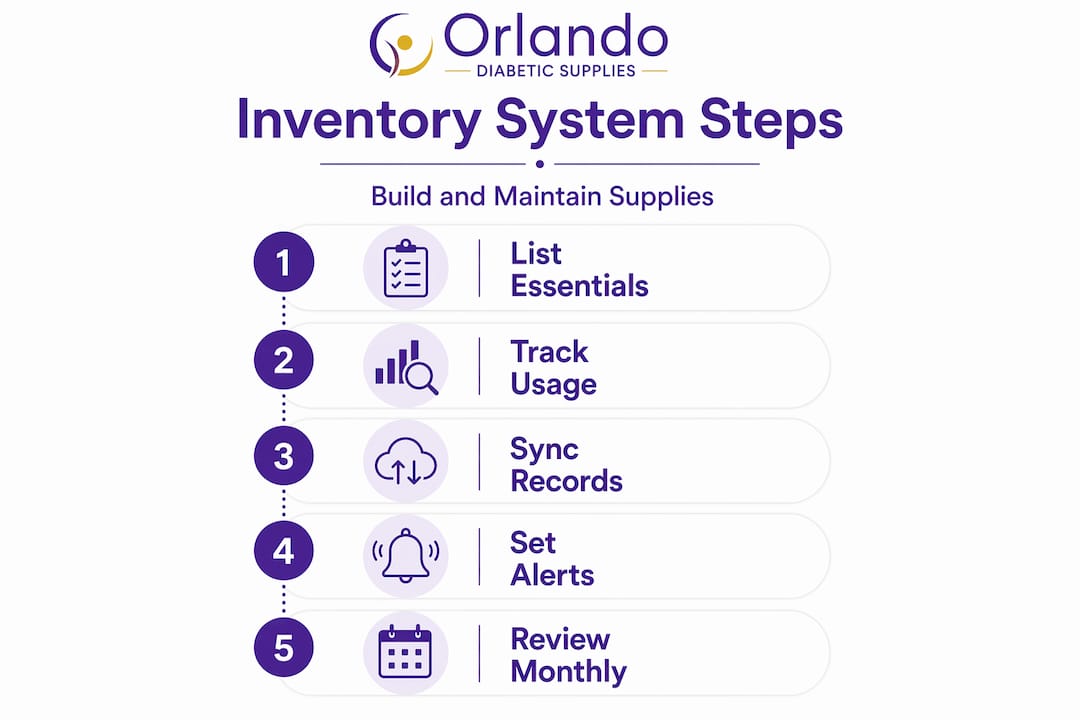
Keeping a good inventory does not require anything fancy. What it does require is consistency. Here is a step-by-step approach that works for most people managing diabetes at home.
- Start with a full count. Go through every drawer, cabinet, and bag where you store supplies. Write down every item, the quantity, and the expiration date printed on the package.
- Choose your tracking method. A simple spreadsheet works well for most people. Apps like KomaDose AI can link supply usage to insulin dose data, which helps when you need to show proof of adherence to your insurer. A physical log in a binder also works, especially for people who prefer not to rely on technology.
- Record the details that matter. For each supply, track: item type, brand, quantity on hand, expiration date, batch number, your typical usage rate per week, and the date you are eligible to reorder based on your prescription schedule.
- Build in prescription and insurance limits. Your reorder date is not just about when you run low. It is tied to when your insurance allows a refill. Add those dates directly into your tracker.
- Set reorder reminders. Two weeks before you are eligible to reorder is a safe lead time. That gives you buffer if there is a shipping delay or a prior authorization requirement from your insurer.
- Flag expiration dates. Tracking batch numbers and expiration dates in a live personal tracker helps prevent you from accidentally using expired components, which can give inaccurate readings or cause other problems.
- Review and update monthly. Set a recurring calendar reminder. A monthly review takes less than 10 minutes once your system is established.
Pro Tip: When you sync your CGM sensor wear-time reports and your physical supply counts in the same tracker, you create exactly the kind of proof of adherence that insurance companies ask for when approving reorders for advanced devices.
Insurance rules and supply overages
This is where many people get caught off guard. Understanding how insurance intersects with your inventory is not optional. It directly affects what you can order, how much, and when.
What Medicare covers
Medicare Part B covers blood glucose monitors and supplies with specific quantity limits based on whether you use insulin. Insulin pump users also benefit from a separate protection: insulin costs are capped at $35 per month under the Medicare drug plan benefit, with no deductible applied.
Private insurers follow their own rules, but most use similar quantity-based limits. Exceeding those limits without documentation creates what is called a diabetic supply inventory overage. An overage is not automatically a problem. But it does require explanation and documentation to avoid a claim denial.
What triggers an insurance audit
| Scenario | What the insurer checks |
|---|---|
| Ordering above quantity limits | Medical records showing increased testing frequency |
| Switching devices mid-year | Prescription and prior authorization documentation |
| CGM sensor reorders | Sensor wear-time downloads and visit notes |
| Duplicate supply claims | Pharmacy invoices and purchase dates |
Patients need in-person or telehealth visits every six months to document continued medical necessity when quantities exceed standard limits. If your inventory shows you have been ordering at a higher rate, that visit documentation is what protects your coverage.
Here is what a sound insurance diabetic supply audit checklist looks like:
- Current prescription matching what you have been ordering
- Physician visit notes from the past six months
- CGM sensor wear-time reports or downloaded glucose logs
- Pharmacy invoices for the past three years
- Prior authorization letters for any advanced devices
Keeping pharmacy invoices for at least three years is one of the most practical things you can do. Those records often clarify administrative errors and protect you if a claim dispute arises.
One more thing most people miss: insurance formularies change yearly, and preferred monitoring brands rotate. The meter or strip brand your plan covered last year may not be preferred this year. Checking your formulary every January as part of your diabetes prescription change checklist can prevent an unexpected out-of-pocket cost mid-year.
Managing common inventory challenges
Even with a solid system in place, real-life complications come up. Here are the most common challenges people run into, and what actually helps.

Coverage changes are the biggest surprise. Patients are often blindsided when preferred monitoring brands rotate yearly. The fix is simple: set a January reminder to review your plan’s formulary and update your diabetic supply list accordingly.
Managing multiple devices at once. Many people use both a CGM and a traditional glucose meter, plus an insulin pump. Each device has its own supply chain and reorder schedule. Keeping a single master inventory document rather than separate lists for each device reduces the chance of things falling through the cracks.
Staying on top of digital and physical records together. Linking supply usage data to health records is one of the most cited challenges in diabetes management. A simple solution: photograph your physical supply counts monthly and attach them to the same folder where you save your CGM reports.
Emergency preparedness. Tracking fast-acting glucose and emergency supplies with a minimum threshold approach means you never order reactively. Set a floor for each critical item. For example, never let your insulin supply drop below a two-week reserve.
Pro Tip: If you have had a prescription change, treat it as a trigger to run a full diabetes prescription change checklist. Verify that your new prescription aligns with what you have on hand, update your insurance records, and check whether the new therapy changes your supply quantities or brand requirements before your next order.
Understanding why diabetic supply benefits go unused is also worth your time. Many people leave covered supplies on the table simply because they did not know they were eligible.
My experience: why inventory discipline changed everything
I have worked with people managing diabetes long enough to see the same story repeat. Someone gets a new CGM device, starts ordering sensors, and never once looks at what is piling up in the cabinet. Then six months later they have a drawer full of expired sensors they cannot use and cannot return.
What I have learned is that inventory discipline is not about being organized for its own sake. It is about staying in control of your own care. When you know exactly what you have, you make better decisions. You reorder on time. You catch a prescription change before it creates a gap in your supplies. You also catch overages before they become a problem with your insurer.
The part most articles skip over is the emotional side. When you do not track your supplies, there is a low-level anxiety that builds up. You are never sure if you have enough. Keeping an accurate inventory removes that uncertainty. It is one of the simplest ways to feel more in control of a condition that can feel unpredictable.
I also think people underestimate how much unused supply accumulates over time. If your prescription changes, if you switch devices, or if your dosing needs shift, you can end up with a real overage. The good news is that sealed, unexpired supplies have real value, and you have options beyond throwing them away.
— Liliana
Turn your extra supplies into cash
If your diabetes supply inventory audit has revealed items you no longer need, sealed and unexpired supplies should not just sit in a drawer.
Orlando Diabetic Supplies Buyback buys unused diabetic supplies right here in Orlando and the surrounding area. We pay same-day cash for Dexcom G6 and G7 sensors, Freestyle Libre, Omnipod, and sealed test strips. The process is simple, fast, and local. No shipping, no waiting, no runaround. If your prescription has changed or you have accumulated an overage, find out how to sell unused supplies for cash and put that money back in your pocket. Visit Orlando Diabetic Supplies Buyback to get started today.
FAQ
What does a diabetic supply inventory include?
A diabetic supply inventory includes all diabetes-related items you manage at home: glucose meters, test strips, lancets, insulin, insulin pens, pump supplies, CGM sensors, alcohol wipes, and sharps containers, along with quantities, expiration dates, and reorder dates.
What is a diabetic supply inventory overage?
A diabetic supply overage occurs when the quantity of supplies you have ordered or received exceeds what your insurance plan or Medicare allows without additional documentation. Overages require medical records or physician visit notes to justify the extra quantities.
How often should I update my diabetic supply inventory?
A monthly review keeps your inventory accurate without taking much time. You should also run a full review any time your prescription changes, your insurance plan renews, or you switch devices.
What records do I need for an insurance diabetic supply audit?
You need current prescriptions, physician visit notes from the past six months, CGM wear-time reports, and pharmacy invoices going back at least three years. Organized records resolve most audit disputes quickly.
How does a prescription change affect my diabetic supply checklist?
A prescription change can shift the brands, quantities, and device types your insurance will cover. Use every prescription change as a trigger to review your full supply list, check the updated formulary, and confirm your new therapy’s supply requirements before placing your next order.