
ReliOn Prime strips are most reliably found at Walmart and Amazon, where 25-, 50-, and 100-count packs are all marked FSA/HSA eligible. Walmart is the go-to first stop: it carries every pack size, ships fast, and the product pages show current pricing with no third-party seller risk. Amazon is a solid backup, especially for Prime members who want two-day delivery, though you should stick to listings sold and fulfilled directly by Amazon to avoid authenticity concerns.
Quick buying snapshot:
- Pack sizes available: 25-count, 50-count, and 100-count
- Price per strip: larger packs typically deliver a lower per-strip cost; the 100-count pack often gives the best per-unit price
- FSA/HSA eligible: yes, on both Walmart and Amazon
- Seller reliability: direct retailer listings (Walmart.com, Amazon sold-by-Amazon) carry far less authenticity risk than third-party marketplace sellers
For most buyers, the one-line verdict is this: check Walmart first for price, then Amazon for shipping speed.
Key Takeaways
ReliOn Prime strips offer the best per-strip value in 100-count packs from direct retailer listings, and compatibility with Prime meters only is non-negotiable.
| Point | Details |
|---|---|
| Best place to buy | Walmart and Amazon (sold by Amazon) offer the lowest prices and FSA/HSA eligibility on all pack sizes. |
| 100-count saves more | The 100-count pack typically delivers the lowest price per strip; factor in shipping when comparing sellers. |
| 90-day rule after opening | Write the opening date on the vial and use strips within 90 days, even if the printed expiry is later. |
| Prime meters only | ReliOn Prime strips work only with ReliOn Prime meters; they are not compatible with any ReliOn Premier model, including Classic, Voice, BLU, or Compact. |
| Orlando Diabetic Supplies Buyback | Sealed, in-date strips you no longer need can be turned into same-day cash through Orlando Diabetic Supplies Buyback in the Orlando area. |
Table of Contents
- How major online sellers compare on price and availability
- A practical checklist for picking the right listing and pack size
- Which meters work with ReliOn Prime strips?
- How to store ReliOn Prime strips so your readings stay accurate
- How to spot expired, unsealed, or counterfeit strips before you buy
- Why sealed, in-date supplies are the only ones worth buying or selling
- You have extra sealed ReliOn Prime strips: here is what to do
- Sources
How major online sellers compare on price and availability
Choosing where to buy comes down to four things: price per strip, pack availability, shipping speed, and how easy returns are if something goes wrong. The table below covers the key variables across the main sellers.
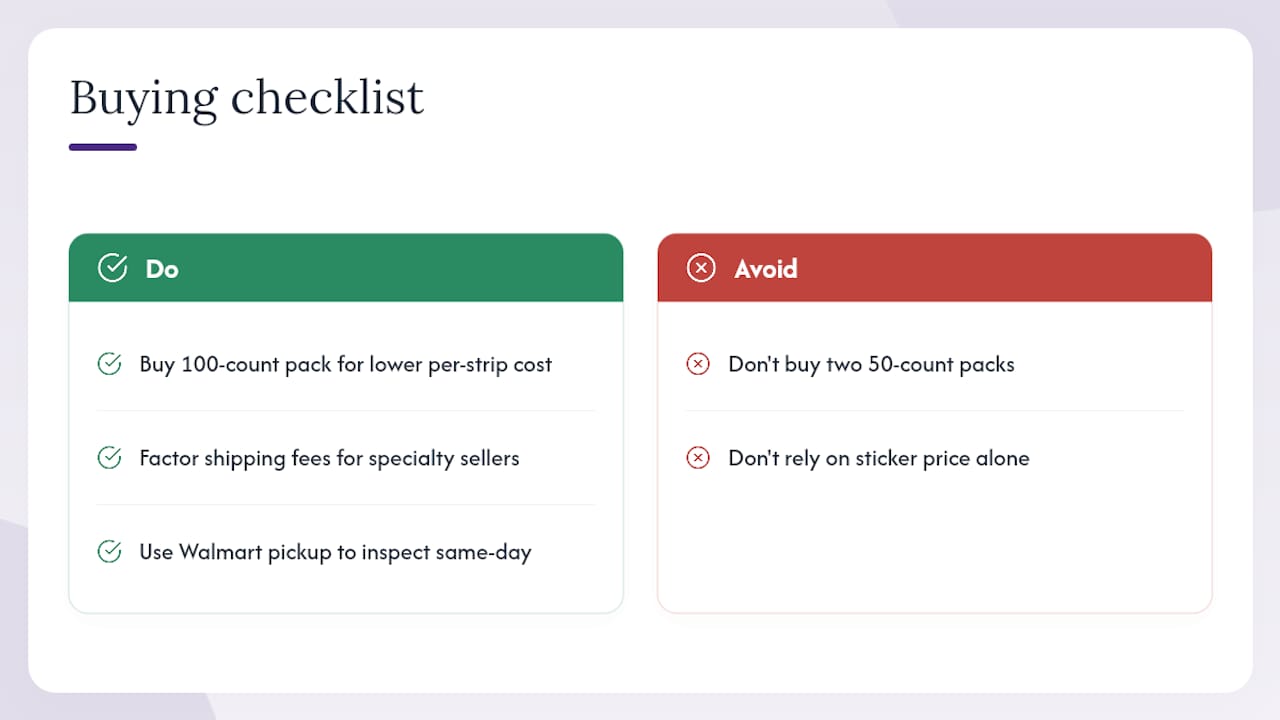
The clearest per-strip savings show up with the 100-count pack. Buying two 50-count packs separately often costs more than one 100-count purchase, so if you test daily, the larger pack is the smarter buy. Factor in shipping fees when comparing specialty sellers, since a lower sticker price can disappear once shipping is added.
Walmart’s in-store pickup option is worth noting: you can order online and collect same-day, which removes any shipping wait and lets you inspect the packaging before you leave the store.
A practical checklist for picking the right listing and pack size
Not every listing for prime blood glucose strips is equal, even on major platforms. These steps help you avoid a bad purchase.
-
Calculate price per strip first. Divide the total price by the strip count. A 50-count pack at $9 is $0.18 per strip; a 100-count at $16 is $0.16. The math takes ten seconds and often changes which pack you choose. For more ways to budget your diabetes supplies, it pays to run this comparison every time you reorder.
-
Check that the listing shows expiration and lot info. A legitimate product page or seller photo should display the vial label clearly, including the lot number and expiration date. If that information is absent, skip the listing.
-
Look for sealed vial photos. The cap should be intact and the foil seal unbroken in any product photo. Open or repackaged vials are a red flag.
-
Verify seller rating and review count. On Amazon, prefer sellers with at least a 95% positive rating and several hundred reviews. A seller with fewer than 50 reviews selling medical supplies deserves extra scrutiny.
-
Confirm FSA/HSA eligibility on the product page. Both Walmart and Amazon mark eligible items clearly. If the listing does not show the FSA/HSA badge, contact the seller before purchasing.
-
Check the product title matches exactly. “ReliOn Prime” and “ReliOn Premier” are different products. A listing title that mixes these names or uses vague language like “ReliOn glucose strips” without specifying Prime is worth double-checking before you buy.
-
Use FSA/HSA payment at checkout. Both Walmart and Amazon accept FSA/HSA cards directly at checkout for eligible items. No reimbursement paperwork needed.
Which meters work with ReliOn Prime strips?
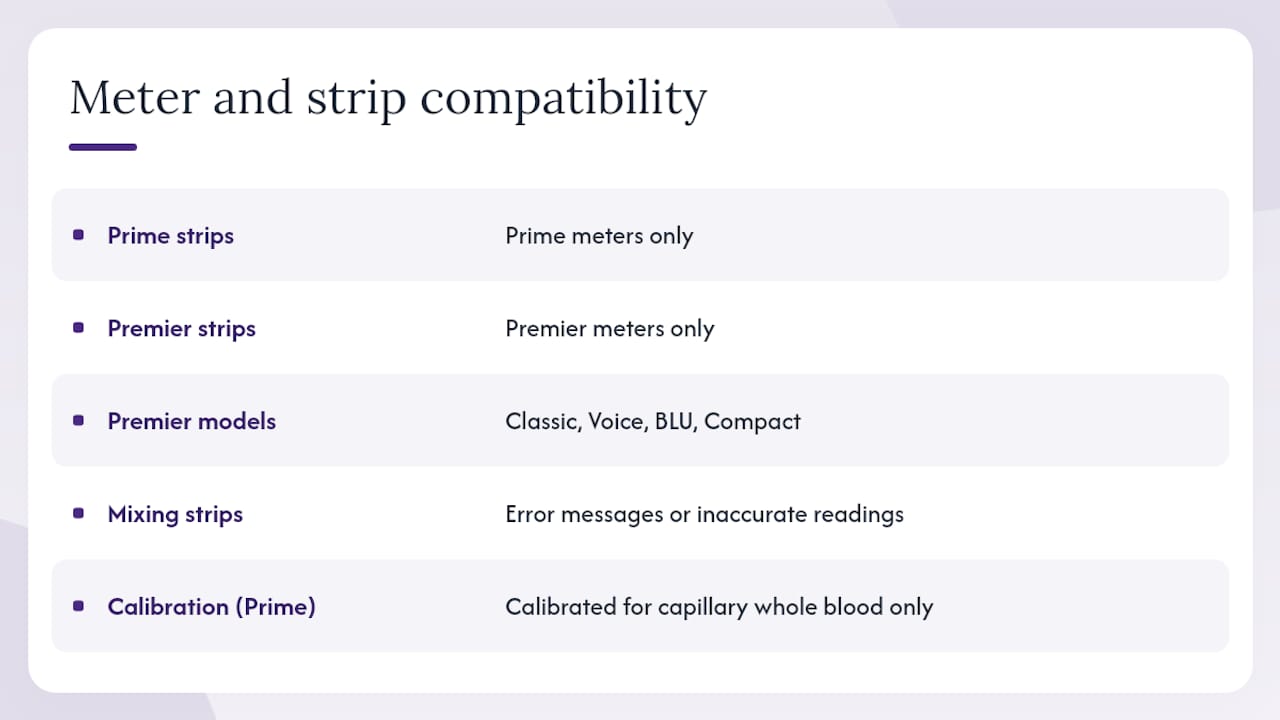
ReliOn Prime test strips are designed for ReliOn Prime meters only; ReliOn Prime strips are not compatible with the ReliOn Premier family, including Premier Classic, Premier Voice, Premier BLU, or Premier Compact. Each strip type must be matched to its own meter.
This is one of the most common and costly mistakes buyers make. The two product lines look similar and share the ReliOn brand name, but the strip chemistry and meter calibration are different. Using Prime strips in a Premier meter, or vice versa, will produce error messages or inaccurate readings. The Premier Compact user manual explicitly states that Premier test strips are for Premier meters only, and the same rule applies in reverse for Prime.
The quick check: look at your meter’s model name. If it says “Prime,” you need Prime strips. If it says “Premier,” you need Premier strips. When in doubt, the model name is printed on the front of the meter and on the original packaging. You can also review why test strip brands matter for a fuller explanation of why mixing strip families causes problems.
One technical note: the ReliOn Prime user guide confirms the system is calibrated for capillary whole blood only. It is not validated for venous samples, serum, plasma, or neonatal use.
How to store ReliOn Prime strips so your readings stay accurate
Storage errors are one of the most overlooked causes of inaccurate glucose readings. The manufacturer’s instructions are specific: keep strips in their original bottle at 39°F–86°F (4°C–30°C), away from direct sunlight and heat sources. Do not refrigerate or freeze them.
Key storage rules to follow:
- Replace the cap immediately after every use. Humidity and heat degrade the strip chemistry fast once the vial is open. Leaving the cap off for even a few minutes during a testing session can affect accuracy over time.
- Never transfer strips to another container. The original bottle is designed to protect the strips. A different container may not provide the same moisture barrier.
- Write the opening date on the bottle. The 90-day rule is firm: use strips within 90 days of opening, even if the printed expiration date on the label is later. A strip opened in January and used in May is out of spec regardless of what the label says.
- Check the expiration date before every new bottle. Online purchases occasionally arrive close to expiration. If a bottle expires within 90 days of delivery, you may not finish it in time.
The “no coding required” feature on ReliOn Prime strips removes one common source of user error. With older strip systems, you had to manually enter a calibration code each time you opened a new vial. Skipping or entering the wrong code could skew results. Prime strips eliminate that step entirely, so every test starts correctly without any setup. Avoiding common strip storage mistakes is just as important as buying from a reliable seller.
The system delivers results in approximately 7 seconds and requires a minimum sample volume of 0.5 µL. If you see an E13 error on your meter, the most likely cause is an insufficient blood sample, not a faulty strip.
How to spot expired, unsealed, or counterfeit strips before you buy
Buying glucose test strips online carries a small but real risk of receiving expired or improperly stored product. These checks protect you.
Before you purchase:
Ask the seller for a clear photo of the vial label showing the lot number and expiration date, and a separate photo of the sealed cap. Sellers who provide this quickly and clearly are far more likely to be legitimate. If a seller refuses or delays, walk away.
Before accepting any delivery of ReliOn Prime strips purchased online, confirm three things: the expiration date on the vial label is at least 90 days out, the cap seal is intact, and the lot number is visible and legible, as recommended by user instructions and best practice guidance. A missing lot number is a meaningful red flag — legitimate manufacturers print it on every vial.
After delivery:
- Check the expiration date on the vial label immediately.
- Inspect the cap seal. It should be tight and show no signs of tampering.
- If you have control solution, run one control test before using the strips on yourself. A result outside the acceptable range printed on the vial label means the strips may have been compromised.
Seller red flags to watch for:
- No expiration date shown anywhere in the listing or seller photos
- Vials shown open or without the original cap
- Seller with fewer than 50 reviews or a rating below 95%
- Product title that does not clearly say “ReliOn Prime”
- Return policy that excludes opened medical supplies with no exceptions
Pro Tip: If a listing’s price is significantly below what Walmart charges for the same pack size, treat that as a warning sign, not a deal. Legitimate sellers rarely undercut major retailers by a wide margin on a commodity product like test strips.
Why sealed, in-date supplies are the only ones worth buying or selling
Sealed, unexpired strips are the only version that protects both the person testing and anyone who later receives them. An open vial, a missing expiration date, or a strip stored outside the recommended temperature range can produce a reading that is off by enough to affect a real health decision.
This matters beyond individual use. When people switch meters, change insurance, or receive more strips than they need, sealed in-date supplies have real resale value. Opened or expired strips do not, and they should not be passed along to anyone else.
The local buyback market in Orlando reflects this clearly: buyers like Orlando Diabetic Supplies Buyback accept only sealed, unexpired supplies precisely because those are the only ones that are safe and legally appropriate to resell. Strips that have been opened, stored improperly, or are past their 90-day window after opening have no resale value and should be disposed of responsibly.
You have extra sealed ReliOn Prime strips: here is what to do
If you have sealed, in-date ReliOn Prime strips you no longer need, turning them into cash is straightforward with Orlando Diabetic Supplies Buyback. Instead of letting supplies expire in a drawer, you can get same-day payment for eligible items in the Orlando area.
Orlando Diabetic Supplies Buyback pays cash on the spot for sealed, unexpired test strips and other diabetic supplies. The process is simple: bring your original, sealed packaging with the expiration date and lot number visible, and the inspection happens in person. No shipping, no waiting for a check in the mail.
How it works:
- Contact Orlando Diabetic Supplies Buyback to confirm your strips qualify
- Bring the original sealed packaging with expiration and lot info visible
- Receive an on-the-spot offer and same-day cash or electronic payment
Eligibility requires that strips be factory-sealed, unexpired, and in original packaging. This is a general information overview; eligibility is confirmed at the time of in-person inspection.
Ready to turn unused supplies into cash? Visit how to get cash for unused diabetic supplies or learn more about selling previous diabetes device supplies to see what qualifies and how the process works.
Sources
- User Instruction Manual
- ReliOn™ Meters – ReliOnBGM
- Walmart
- ReliOn Prime Blood Glucose Test Strips User Guide