Not all diabetic supplies are created equal, and the differences between brands can affect your blood sugar control, your comfort, and your monthly budget more than most people realize. Getting diabetic supply brand differences explained clearly is something many people with diabetes wish they had done sooner. The brand you choose for your continuous glucose monitor (CGM), test strips, or lancing device determines far more than just which box sits on your shelf. It shapes your entire management routine. This guide breaks down what actually matters when comparing brands so you can make confident, informed decisions.
Table of Contents
- Key takeaways
- Diabetic supply brand differences explained: the major categories
- Technology and usability differences between brands
- Cost factors and insurance coverage by brand
- Authenticity, counterfeits, and how to stay safe
- Choosing the best brand for your specific situation
- My take on navigating diabetic supply brands
- Turn your unused diabetic supplies into cash today
- FAQ
Key takeaways
| Point | Details |
|---|---|
| Brands are not interchangeable | Supply ecosystems, sensor compatibility, and device software vary significantly between manufacturers. |
| Total cost matters more than device price | Recurring consumables and ecosystem lock-in drive long-term costs far beyond the initial device investment. |
| Authenticity protects your health | Counterfeit diabetic supplies carry serious safety risks and should be verified through packaging lot numbers and authorized sources. |
| Insurance shapes your brand options | Coverage preferences for specific brands can limit or unlock significant savings, especially for CGMs. |
| Simplicity often beats complexity | For many users, a reliable, straightforward device outperforms a feature-heavy one that creates room for user error. |
Diabetic supply brand differences explained: the major categories
Before comparing brands, you need a clear picture of what you are actually comparing. Diabetic supplies fall into several categories, and each one has its own set of leading brands with distinct approaches.
Continuous glucose monitors (CGMs) are among the most brand-specific supplies available. Dexcom G7, Abbott FreeStyle Libre 3 Plus, and Abbott Lingo are prescription or over-the-counter options with different sensor wear times, app ecosystems, and accuracy profiles. Dexcom and FreeStyle Libre do not share sensors or receivers. Choosing one means committing to that brand’s full system.
Blood glucose meters and test strips include brands like Accu-Chek, OneTouch, Contour Next, and Reli On. Test strips are almost always brand-specific. An Accu-Chek strip will not work in a OneTouch meter. This matters both for cost and for convenience when traveling or switching insurers.
Lancing devices and lancets split into two camps:
- Proprietary systems like Accu-Chek’s FastClix drum, which loads six lancets at once and reduces needle handling
- Universal lancets like TRUEplus, which fit most standard lancing devices and typically cost less
Insulin delivery systems include pens, syringes, and patch pumps like Omnipod. Each has brand-specific cartridges or pods, and switching systems usually requires a new prescription and an adjustment period.
Knowing which category you are shopping in clarifies which brand differences actually apply to your situation. A diabetic supply comparison only helps when you compare like to like.
Technology and usability differences between brands
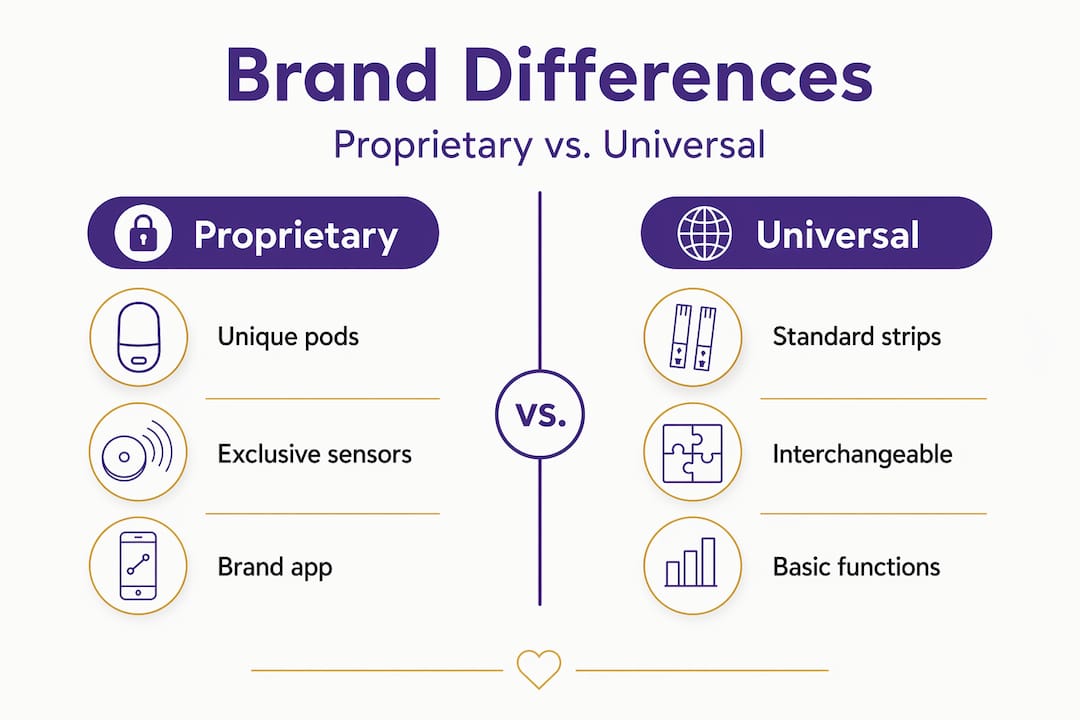
This is where the real divergence between brands shows up. The single biggest difference across top diabetic supply brands is whether they use a proprietary ecosystem or a universal, open system.
Proprietary vs. universal systems
Proprietary vs. universal ecosystems represent the biggest differentiator between brands. Proprietary brands like Accu-Chek lock you into their specific devices but often deliver specialized safety and convenience features in return. Universal brands like TRUEplus offer lower cost and flexibility, meaning you can mix and match with other devices.
Accu-Chek’s FastClix drum system is a good example. It loads a drum of six lancets, eliminating individual needle handling and reducing accidental stick risk. That is genuinely useful for someone who tests frequently or has dexterity challenges. But it also means you can only buy Accu-Chek drums going forward.
| Feature | Proprietary brands (e.g., Accu-Chek) | Universal brands (e.g., TRUEplus) |
|---|---|---|
| Lancet compatibility | Brand-specific only | Works with most standard devices |
| Convenience features | Advanced (drum loading, auto-eject) | Basic, manual |
| Cost over time | Higher due to lock-in | Lower, more competitive options |
| Switching flexibility | Difficult, requires new device | Easy, drop-in replacement |
| App integration | Often available | Rarely available |
Usability and your tech comfort level
For CGMs, app integration is a major differentiating factor. Dexcom G7 connects directly to smartphones and shares data with providers in real time. FreeStyle Libre 3 Plus offers similar connectivity. But simpler meters outperform complex models for users who are not tech-savvy, where advanced features can introduce user error rather than reduce it.
A straightforward glucometer that gives a clear reading and stores data reliably will serve most non-tech users better than a Bluetooth-enabled device they do not fully understand.
Pro Tip: If you are not sure which CGM ecosystem fits your life, ask your provider if they offer a trial period or sample sensors before committing to a 90-day supply. It is much easier to switch before your insurance locks in your annual allowance.
Cost factors and insurance coverage by brand
Price is where many people get surprised. The upfront device cost is rarely the issue. The ongoing consumable costs are what add up.
What you actually pay month after month
Recurring consumables like test strips are the main cost driver, not the meter itself. Brands like Abbott and Dexcom focus heavily on ecosystem retention through proprietary software and sensors, which elevates long-term costs. A meter that costs $20 upfront might lock you into $60 per month in brand-specific strips.
For CGMs specifically, the numbers are significant. OTC CGMs cost about $89 to $99 per month, while prescription models like Dexcom G7 and FreeStyle Libre 3 Plus offer manufacturer savings programs that can reduce costs by over $200 per month compared to full list prices.
Key cost considerations when choosing a brand:
- Insurance tier placement: Many plans place Dexcom and FreeStyle Libre on preferred formulary tiers, which means lower copays. Off-formulary brands can cost significantly more even if the retail price looks similar.
- Manufacturer assistance programs: Dexcom and Abbott both offer patient assistance programs that can bring monthly costs close to zero for qualifying users. These programs are often underutilized.
- Switching costs: If you have built a routine around an Accu-Chek ecosystem, switching to a universal brand mid-year may mean buying a new device out of pocket if your insurance already covered your annual allowance.
- Hidden long-term costs: Evaluating total long-term cost rather than just device price is the smarter approach, since consumables and ecosystem compatibility impact your annual expenses far more than the sticker price suggests.
It also helps to check whether your plan covers unused supply benefits that you may be leaving on the table each year.
Authenticity, counterfeits, and how to stay safe
Diabetic supply authenticity explained clearly is not just a consumer protection topic. It is a health and safety issue. Counterfeit diabetic products are more common than most people expect, and the consequences of using them can be serious.
Why counterfeit supplies are a real threat
Counterfeit medical products present serious health dangers due to unknown chemical contents and unreliable error code signals. An FDA Class I recall found that error codes on counterfeit glucose monitoring systems were indistinguishable from those on real devices, meaning a dangerous blood sugar reading could be misread as a strip error.
Beyond glucose meters, the GLP-1 medication space has seen a surge in fakes. Counterfeit GLP-1 pens sold for $400 to $600 are often produced for as little as $40, with no clinical use and serious health risk to the buyer.
Personal importation of diabetic medications is another major safety risk. Products sourced outside the authorized supply chain carry no guarantee of chemical consistency or sterility, even when they appear identical to legitimate products.
How to verify your diabetic supplies are authentic
- Check lot numbers on all packaging components. Matching lot numbers on the carton, pen label, and cap sticker are a strong authenticity signal. Mismatched numbers indicate a high likelihood the product is counterfeit.
- Scrutinize expiration dates. Implausible or irregular expiration dates are a red flag. Legitimate products have clearly printed, consistent dates across all packaging.
- Never remove or tamper with labels. Removing labels to “check underneath” actually voids your ability to validate authenticity, since verification depends on intact packaging.
- Buy from authorized sources only. Pharmacies, medical supply companies with verified credentials, and manufacturer-authorized distributors are your safest options.
- Report suspicious products to the FDA. If something seems off about your supplies, the FDA MedWatch program accepts consumer reports and investigates counterfeit medical products.
“Counterfeit drugs and devices are not just ineffective. They are actively dangerous. Buying outside the authorized supply chain means accepting an unknown risk every single time you use the product.”
Pro Tip: Before buying diabetic supplies from any online seller, look for their pharmacy license number and verify it with your state’s board of pharmacy. A legitimate seller will not hesitate to provide this information.
Choosing the best brand for your specific situation
Understanding diabetic products is one thing. Applying that understanding to your own life is another. Here is how to think through the choice practically.
- Assess your tech comfort level first. If you want real-time data sharing with your doctor and you are comfortable with apps, a Dexcom G7 or FreeStyle Libre 3 Plus makes sense. If you want reliable readings without the learning curve, a quality standard glucometer is a better fit. There is no universal answer on which diabetic brand is best for every person.
- Map your insurance coverage before committing. Call your insurer and ask which brands are on the preferred formulary tier. A brand that seems expensive at retail may be nearly free with the right coverage, and vice versa.
- Consider your provider’s data preferences. Some endocrinologists and diabetes educators strongly prefer CGM brands that integrate with their clinical software. Using a compatible brand can improve the quality of your appointments and care adjustments.
- Evaluate your total annual cost, not just monthly. Factor in the device, sensors or strips, any required receivers or transmitters, and whether your insurance has an annual supply cap.
- Think about what happens when you switch. Moving from a proprietary system to a universal one, or from one CGM brand to another, can require new prescriptions, insurance reauthorizations, and a learning period. Budget time and cost for that transition.
- Check whether you have unused supplies from your current brand. If you are switching, you may be able to sell your unused test strips or sensors rather than let them expire.
My take on navigating diabetic supply brands
I have seen a lot of people make the same mistake: they pick a brand based on the device price, fall in love with the gadget, and then quietly absorb the ongoing supply costs without realizing they signed up for an ecosystem. That ecosystem lock-in cost is the thing most brand reviews skip entirely, and it matters more over 12 months than almost any other factor.
What I have also found is that simplicity is chronically underrated. The best glucose meter for you balances features with user comfort. A sleek CGM with six integrated apps will not help you if it creates anxiety every time you check your readings. A basic meter you trust and actually use consistently will always beat a sophisticated one you second-guess.
On authenticity, I want to be direct. The risk of counterfeit diabetic supplies is not theoretical. Personal importation of diabetes medications poses serious health risk because unregulated products have unknown quality and potency. No amount of savings justifies that. Stick with authorized sellers, verify your packaging, and if a deal looks too good to be true on a medical device, it almost certainly is.
My honest advice: choose the brand that fits your lifestyle and your insurance, verify everything you buy, and do not let unused supplies sit in a drawer losing value.
— Liliana
Turn your unused diabetic supplies into cash today
If you have switched brands, adjusted your prescription, or found yourself with extra sealed supplies, Orlando Diabetic Supplies Buyback is here to help. We buy unused Dexcom G6 and G7 sensors, FreeStyle Libre, Omnipod, and sealed test strips from people in Orlando and surrounding areas. Fair pricing, fast communication, and same-day cash. No hassle, no waiting.
Visit our get cash for supplies page to see exactly what we accept and how the process works. You can also explore the full Orlando Diabetic Supplies Buyback website for local buyback options, trusted brand guides, and practical tips for managing your diabetic supply budget in 2026. Getting extra cash for supplies you are no longer using is one of the easiest wins available to you right now.
FAQ
What is the biggest difference between CGM brands?
The biggest difference is ecosystem compatibility. Dexcom and FreeStyle Libre use proprietary sensors that only work within their own systems, which affects both cost and long-term flexibility.
How do I know if a diabetic supply is counterfeit?
Check that lot numbers match across the carton, pen label, and cap sticker. Mismatched numbers or implausible expiration dates are strong indicators of a counterfeit product.
Which brand is better for non-tech users: CGM or standard meter?
For non-tech users, a reliable standard glucometer often performs better in practice. Simpler devices reduce user error and build consistent testing habits more effectively than feature-heavy CGMs.
Does insurance dictate which diabetic supply brand I should use?
Yes, in many cases. Insurers assign brands to formulary tiers, meaning your out-of-pocket cost can vary dramatically depending on which brand your plan prefers, even for similar products.
Can I sell my unused diabetic supplies if I switch brands?
Yes. Sealed, unexpired supplies from brands like Dexcom, FreeStyle Libre, and Omnipod can often be sold to local buyback services like Orlando Diabetic Supplies Buyback for same-day cash.