A pickup radius is the distance a local business will travel from its base to meet a customer. If you are selling unused diabetic supplies, it decides whether we can come to you the same day. We buy sealed, unexpired supplies in Orlando and the surrounding areas, and we meet you in a safe, public local spot. This guide explains what a radius means, which communities people count as Orlando, and how to confirm your location in a few minutes.
TL;DR
- A pickup radius is a boundary around a base location. Inside it, a provider can book you. Outside it, usually not.
- We serve Orlando and surrounding areas, and we meet in safe, local public places instead of shipping.
- Drive time matters as much as miles. A short trip on a map can be a long one at rush hour.
- To check your address, send us your city or ZIP code and the items you have. We confirm before anyone drives anywhere.
- Sealed, unexpired supplies such as Dexcom G7 sensors, Omnipod 5 pods, Libre 3 and Libre 3 Plus sensors, and sealed test strips are what we look for.
Table of Contents
- What a pickup radius actually means
- Our service area: Orlando and surrounding areas
- Which communities count as the Orlando area
- Why drive time matters more than miles
- How to check whether your address is covered
- What we buy and what you can expect to be paid
- Weekends and flexible timing
- Get a quick answer for your address
- Our perspective
- Safe selling: a few habits that help
- FAQ
- Sources
What a pickup radius actually means
For a local service, the radius is how far in miles a provider is willing to travel from a central address. Booking tools used by local businesses describe it the same way: customers outside the boundary cannot book.
There are a few things worth knowing about how radii work in practice:
- Where the circle starts. The center is the provider’s base or start point, not the middle of a city. Different businesses with the same “Orlando” label can have very different coverage.
- How distance is measured. Some systems measure in a straight line, not by road. One transport provider’s admin guide says distances are measured as the crow flies. A straight-line mile and a driving mile are not the same.
- Miles or minutes. Some services set a maximum drive time instead of a distance. One scheduling platform uses traffic-aware estimates for this, which shows that a stated radius is not always the same as practical driving distance.
The takeaway: do not rely on a number alone. What you want to know is whether someone can reach you at a time that works, in reasonable traffic.
Our service area: Orlando and surrounding areas
We buy unused diabetic supplies in Orlando, Florida and the areas around it. We meet in safe, local public locations, and we pay on the spot for items that pass inspection. We skip shipping on purpose. Mailing a box means waiting, tracking and hoping, while a meetup means you see the supplies checked and get paid in the same visit.
We do not publish a fixed mileage cap on this page, and we do not want to guess one for you. The simplest approach is to tell us where you are. If you are in Orlando or one of the nearby communities below, there is a good chance we can work something out. If you are farther out, ask anyway. We would rather answer a quick question than have you assume the answer is no.
For the step-by-step on how meetups work, see our page on how pickup works in Orlando.
Which communities count as the Orlando area
“Orlando” means different things depending on who you ask. The city limits are small compared with the region people live in.
The metro area is officially made up of four counties: Lake, Orange, Osceola and Seminole. The Orlando Economic Partnership’s metro data sheet lists them that way. The Greater Orlando overview names the cities and suburbs people commonly group with Orlando.
| Area | Typical examples |
|---|---|
| Central and downtown | Downtown Orlando (ZIP 32801), Lake Eola area, Thornton Park |
| North and northeast | Winter Park, Maitland, Altamonte Springs, Lake Mary, Sanford |
| West and northwest | Ocoee, Winter Garden, Windermere, Apopka |
| South and southeast | Lake Nona, Kissimmee |
The city’s own site confirms that ZIP code 32801 is in downtown Orlando, home to City Hall. If you search for “Radius Orlando” and land on apartment listings near that ZIP, that is a different business. We are a diabetic supply buyback, and the “radius” we mean here is simply how far we travel.
A city on this list is not a guarantee, and a city missing from it is not a refusal. It is a starting point for the conversation.
Why drive time matters more than miles
Orlando traffic is the reason a distance on a map can mislead you. The same guidance that explains radii also tells businesses to weigh drive time, appointment volume and customer expectations alongside distance.
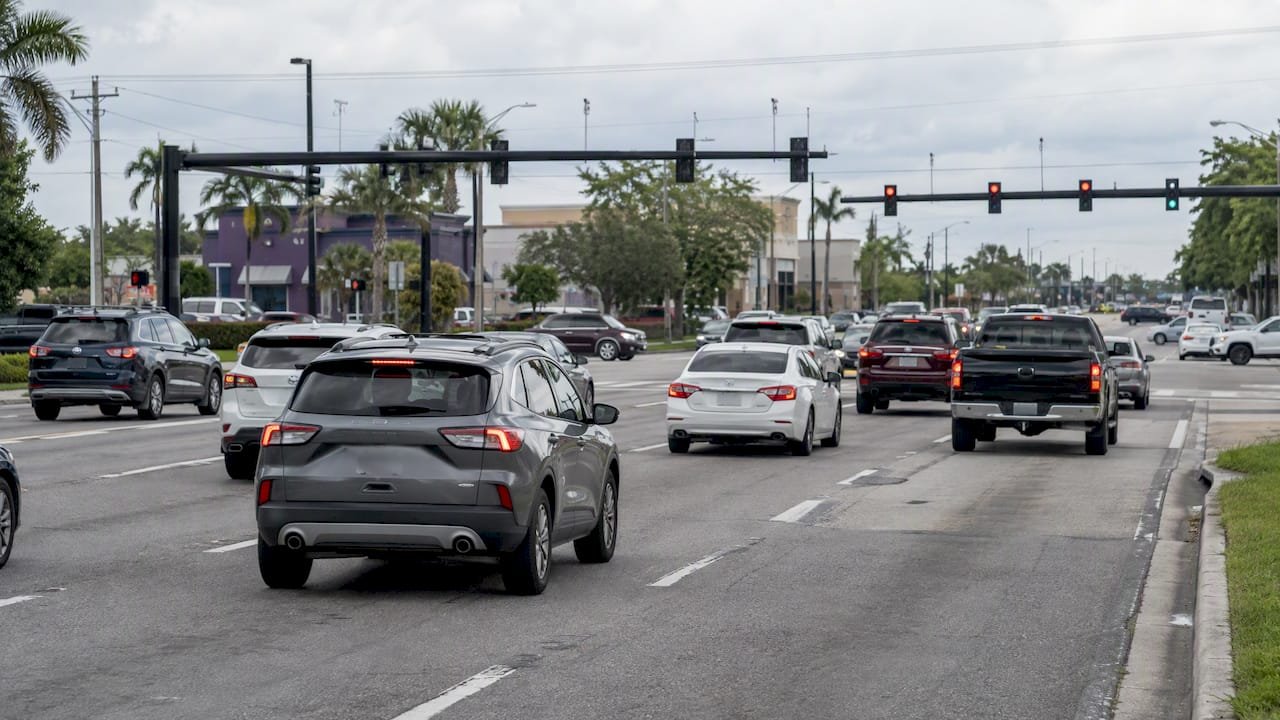
Here is a real-world example. Uber’s route page lists Orlando to Ocoee at roughly 10 miles and about 19 minutes. That is a short trip. But it is an estimate for a typical trip, and rush hour on the main roads can change it.
What this means for you:
- Pick a meeting spot that is easy to reach for both sides. A public place with parking near a main road usually works better than a spot deep in a neighborhood.
- Offer a flexible time window. Midday is often easier than the commute hours.
- Tell us the part of town you can reach, not just your address. A shopping center, a library parking lot or a spot near your workplace can make the meetup quicker.
Other industries set their limits differently, which shows there is no single standard for “nearby”. A chauffeur service covers towns within 50 miles of Orlando International Airport and charges for miles beyond that. A car rental company says it picks up from the first non-airport location within 10 miles, when that branch can provide the service. Each business picks the number that fits its model. Ours is built around quick, local meetups.
How to check whether your address is covered
You do not need to work out a radius yourself. Checking takes a few minutes.
- Send your city or ZIP code. That is enough for a first answer. Other local services work the same way. One local pickup service asks customers to give their ZIP code to confirm route availability.
- List what you have. Brand, product and quantity. For example, “two boxes of Dexcom G7 sensors” or “three boxes of sealed test strips.”
- Check the expiration dates and packaging. We look for unused, sealed, unexpired items. Opened or damaged boxes are usually a problem.
- Tell us when you are free. Give us a day and a window. Same-day meetups depend on timing and on how far apart we are.
- Agree on a public meeting spot. We use safe, local public locations.
Why not just trust a map or a website listing? Because a business that collects your address has not necessarily promised to serve it. One booking guide points out that eligibility should be validated against ZIP codes, service type and capacity before an appointment is final. We do the same: we confirm with you before anyone travels.
One more detail on online listings. Google’s help page for service-area businesses says a business profile cannot set coverage as a simple distance radius. It has to name cities, postal codes or other defined areas. So a listing that shows “Orlando” does not tell you the real reach. Asking directly does.
What we buy and what you can expect to be paid
We focus on unused diabetic supplies that are sealed and unexpired:
- Dexcom G7 sensors
- Libre 3 and Libre 3 Plus sensors
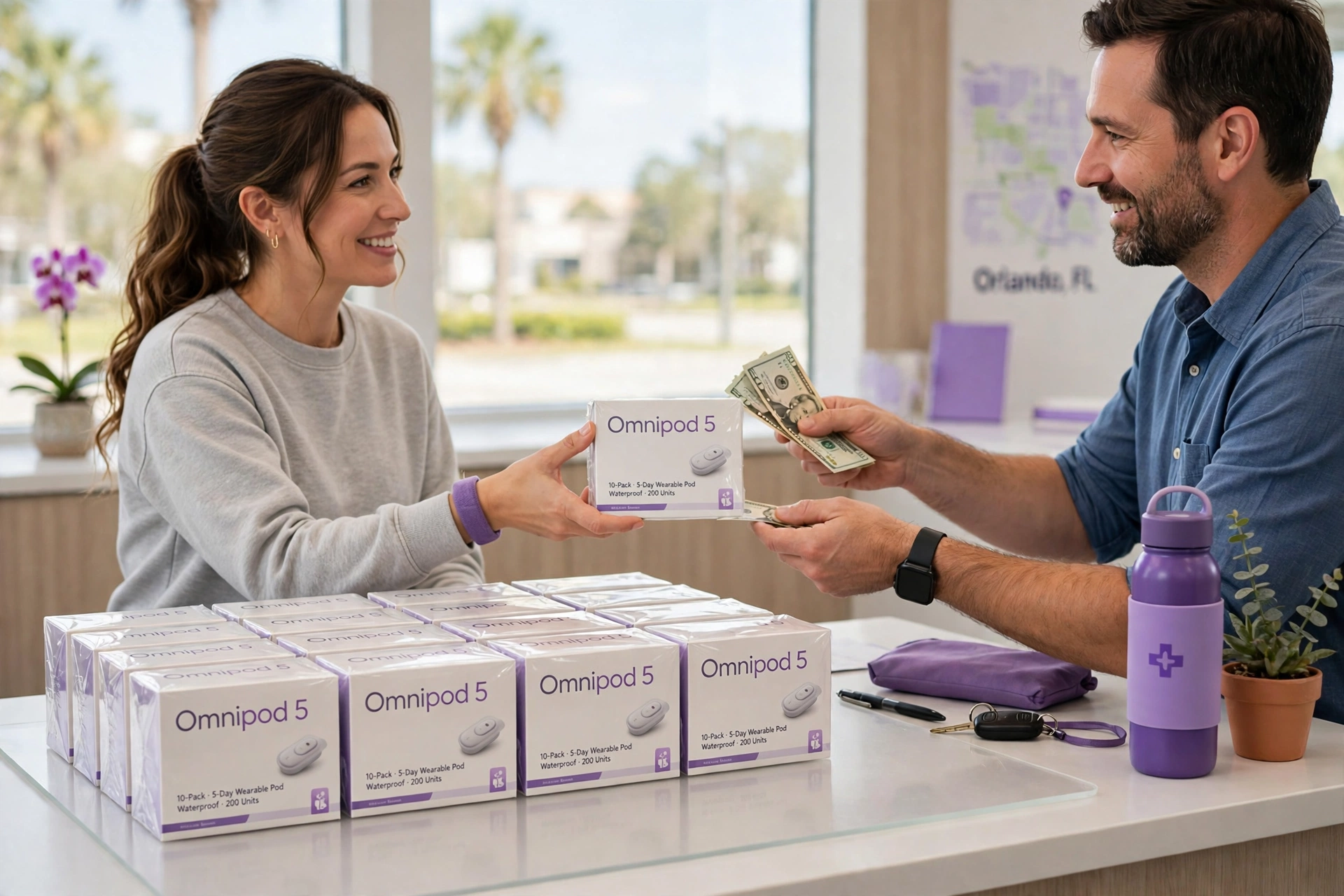
- Omnipod 5 pods
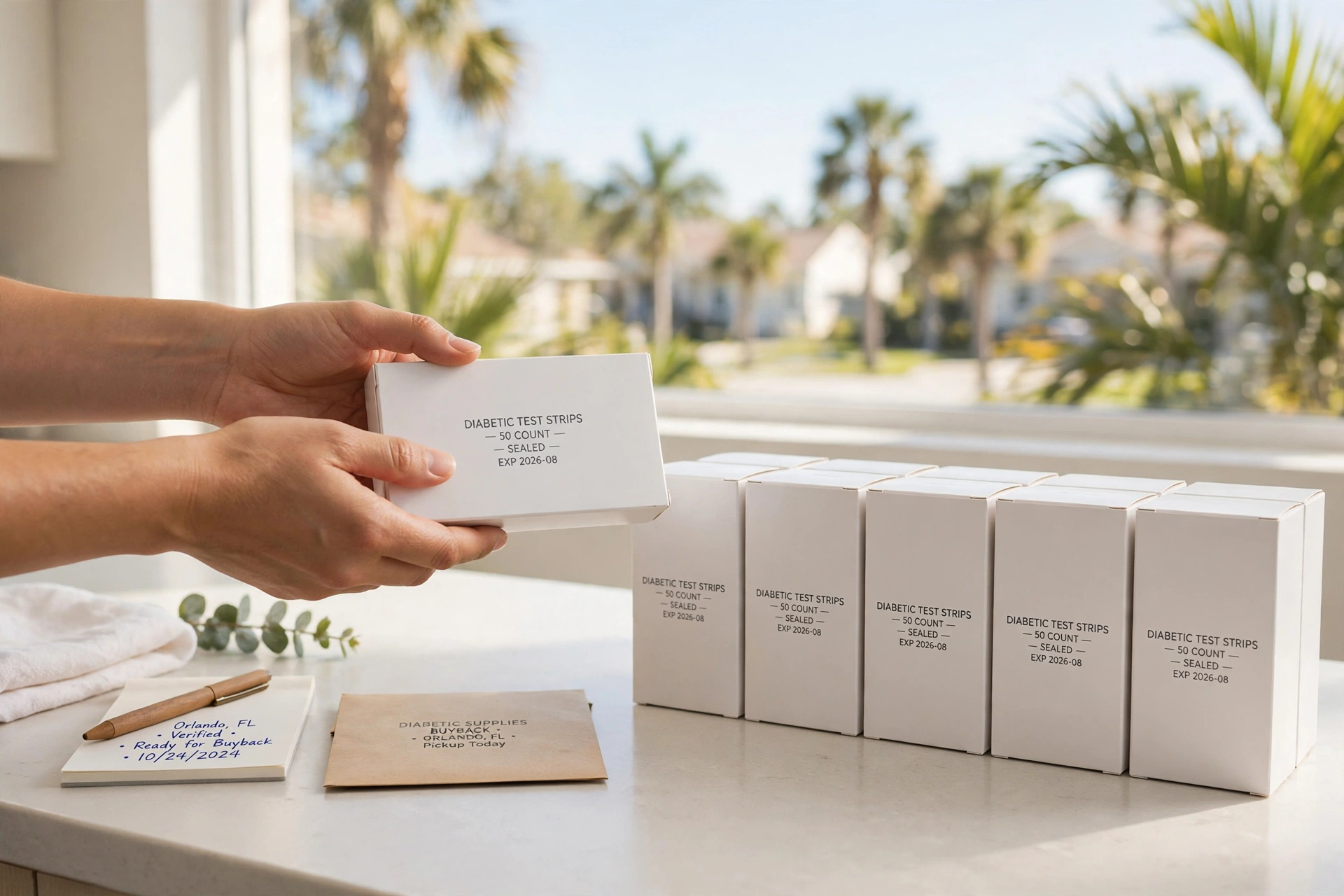
- sealed test strips
Two published prices, so you have a sense of scale. For an unused Dexcom G7, our page lists $70-$90 per pack. For a FreeStyle Libre 2, it lists $15-$20 per sensor. Other items are priced after we see them, and the final offer depends on the item, the quantity and its condition. You can read more on our Dexcom G7 buyback page and FreeStyle Libre 2 buyback page.
If you are not sure what your leftovers are worth, our guide to what leftover supplies are worth in Orlando walks through it. Sellers often end up with extras after a prescription change, a switch to a new device, or an insurance supply that exceeds what they use. Our page on common device upgrades covers those situations.
Weekends and flexible timing
Pickup radius is only half of the question. The other half is when. If weekdays are hard for you, see our page on weekend pickup in Orlando. For a full picture of the process from first message to payment, the buyback timeline lays out each step.
Get a quick answer for your address
If you have sealed, unexpired supplies and want to know whether we can meet you, start with a message. Tell us your city or ZIP code and what you have. We will tell you whether we can come and when. You can begin on our Cash for Diabetic Supplies page.
We pay on the spot for eligible items after in-person inspection, so you leave the meetup with your money and your supplies out of the closet.
Our perspective
We built this service around one idea: meeting locally is simpler than mailing a box. Shipping adds waiting, tracking and the worry that something gets lost. A short meetup in a safe public place lets you see your supplies checked and get paid in the same visit.
That is why we think about our pickup area the way you do, in terms of how easy it is to get to each other. A number of miles does not tell the whole story. A friendly meeting spot, a good time of day and a quick reply do more.
Our advice is simple. If you have sealed, unexpired supplies you will not use, do not let them sit until they expire. Send us your city, tell us what you have, and we will give you a straight answer on whether we can meet. We aim to keep it fair, fast and clear.
Liliana
Safe selling: a few habits that help
When you sell supplies in person, a few habits protect you:
- Meet in a public, well-lit place, and bring the items in their original packaging.
- Keep your prescription label and personal health details private. A buyer only needs to see the product.
- Check expiration dates before you message us, so we can give you an accurate answer.
- If you are on Medicaid or another program that covered the supplies, read up on the rules first. Our page on selling sealed supplies in Florida explains the fraud risks, and your plan or a pharmacist can answer questions about your coverage.
If you are comparing options, our page on local versus online selling covers the tradeoffs between a local meetup and mailing items out.
FAQ
What is the pickup radius for Orlando?
We serve Orlando and the surrounding areas, and we do not publish a fixed mileage cap. Send us your city or ZIP code and we will confirm whether we can meet you. Drive time and the meeting spot matter as much as distance.
Do you cover Winter Park, Kissimmee, Apopka and other nearby cities?
These are all communities people commonly group with the Orlando area. Tell us which one you are in and what you have, and we will let you know if a same-day meetup works. If you are farther out, ask anyway.
Do you ship or mail supplies?
We focus on in-person meetups in safe, local public locations. We do this to avoid the delays and risks of shipping, and so you can be paid on the spot for eligible items.
What should I send when I ask about pickup?
Send your city or ZIP code, the brand and quantity of your supplies, and their expiration dates. Add a day and time window that suit you. That is enough for us to give you a clear answer.
Which supplies are eligible?
We look for sealed, unexpired, unused items, including Dexcom G7 sensors, Omnipod 5 pods, Libre 3 and Libre 3 Plus sensors, and sealed test strips. Opened or damaged packaging can affect whether we can buy an item.
Sources
- Availability and Service Area: configuring your service area
- Trip Range, PHO Admin
- Set Service Area Max Drive Time, TIDY Pro Docs
- Orlando MSA Data Sheet, Orlando Economic Partnership
- Greater Orlando
- International Affairs, City of Orlando
- Orlando to Ocoee route, Uber
- Orlando International Airport (MCO) transfers
- Will Enterprise pick me up?
- Free Dry Cleaning Pickup and Delivery
- Customer Addresses and Mobile Service Areas, Booking Handbook
- How to use a service area on Google